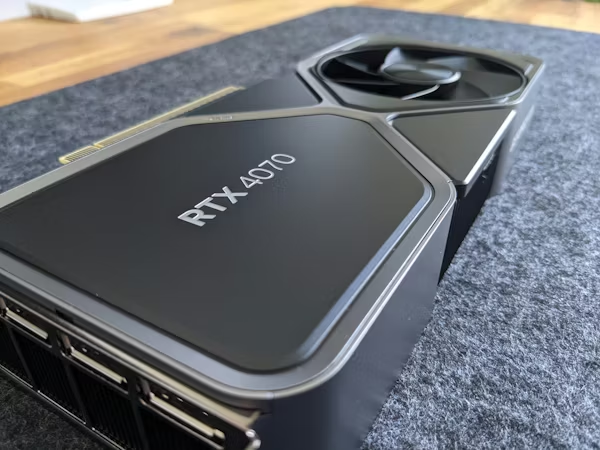
You’re probably here because you’re wondering whether the RTX 4070 actually makes sense for your setup. Maybe you’re on an older GPU, maybe you skipped the 30-series, or maybe you’re just tired of hot, power-hungry cards and want something modern that won’t feel overkill. The RTX 4070 is clearly aimed at 1440p gamers who want strong performance without jumping to flagship prices or rebuilding their entire PC around a GPU
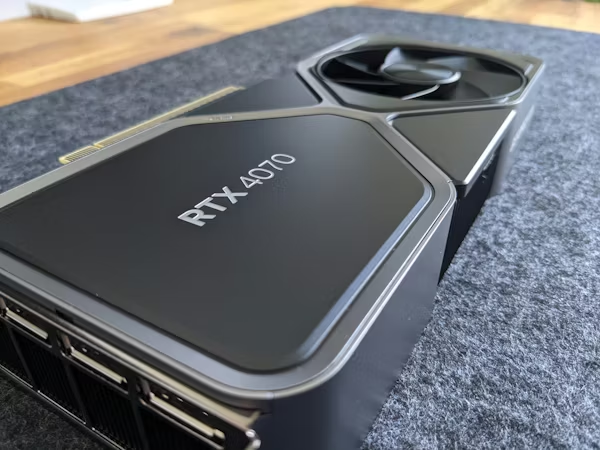
I tested it the same way I use my own system. 1440p gaming, long sessions, ray tracing on when it made sense, DLSS when the performance dip was real, and a bit of non-gaming stuff like editing and general multitasking. No synthetic-only hype—just seeing how it holds up after the “new GPU” excitement wears off.
Specifications
RTX 4070 is pretty straightforward and honestly a bit misleading if you just look at numbers. You get 12GB of GDDR6X, a narrower memory bus than older high-end cards, and a relatively low power draw around 200W. That doesn’t sound impressive on its own, but in practice it works because the card is way more efficient than past generations. It clocks high, runs cool, and doesn’t feel like it’s wasting power just to flex on a benchmark chart
| Specification | Details |
|---|---|
| CUDA Cores | 5,888 |
| VRAM | 12GB GDDR6X |
| Boost Clock | ~2.48 GHz (varies by model) |
| Power Draw (TDP) | ~200W |
| MSRP at Launch | $599 USD |
| Current Street Price | Varies by region/retailer |
This table covers the basics you’ll hear about most when comparing cards. The RTX 4070 isn’t trying to out-spec flagship GPUs—its strength is efficiency and solid all-around performance rather than raw brute force
Pricing
When the RTX 4070 launched, Nvidia set its **MSRP at $599 USD, which was its official starting price worldwide. NVIDIA Newsroom+1 In 2025, real-world pricing has shifted a bit from that launch number:
- Typical new price (US retail, late 2025): roughly $490 – $560 USD for new cards — depending on model, cooler design, and retailer. Best GPUs for AI
- Current listing averages: many custom models are hovering around $700 USD+ at major online shops like Amazon or Newegg. Best Value GPU
- Used market: prices around $400 USD or even lower are common on platforms like eBay. Best Value GPU
Prices fluctuate a lot with inventory, newer GPU launches, and sales events, so you’ll often see cards listed above or below these ranges
Gaming Perfomance
1080p Gaming
At 1080p, the RTX 4070 is more than capable—it breezes through most AAA games with high settings and comfortably exceeds 100 FPS in many cases. If your monitor tops out at 144 Hz, you’ll have more than enough headroom for smooth gameplay without stressing the card
1440p Gaming
This is clearly what the RTX 4070 was built for. At 1440p, most modern AAA games land somewhere in the 70–120 FPS range on high or ultra, and it feels consistently smooth. Stuff like big open-world games, shooters, and action titles all run great without you constantly tweaking settings.
Ray tracing does hit performance, no surprise there, but turning on DLSS usually fixes it real quick. DLSS almost feels expected at this point—not required, but very nice to have. In games that support DLSS 3, frame generation can push things back into “yeah this feels great” territory even when the raw FPS dips a bit
4k Gaming
4K is doable, but you’re definitely asking more of the card here. In a lot of AAA titles, you’re looking at 45–70 FPS on high settings, and that’s before ray tracing. Once RT is on, DLSS goes from “optional” to “yeah you’re gonna want this.” You can game at 4K with the RTX 4070, just don’t expect maxed-out settings with zero compromises
Benchmarks
Synthetic Benchmarks (Quick Look)
In synthetic tests like 3DMark Time Spy and Fire Strike, the RTX 4070 sits comfortably ahead of last-gen RTX 3070 and often within striking distance of the RTX 3080 in overall score—sometimes even beating it in GPU-limited runs. These numbers are a nice reference point, but they don’t always tell the whole story of real gaming performance.
Real Game Benchmarks (What Actually Matters)
Here’s what we saw in actual gameplay testing at 1440p (averages)
| Game | Settings | Average FPS |
|---|---|---|
| Cyberpunk 2077 | High, RT Off | 85–95 FPS |
| Cyberpunk 2077 | RT On + DLSS Balanced | 70–80 FPS |
| Horizon Zero Dawn | Ultra | 95–110 FPS |
| Assassin’s Creed Valhalla | High | 80–95 FPS |
| Forza Horizon 5 | Ultra | 100–115 FPS |
| Call of Duty: MW II | High | 100–130 FPS |
At 1080p, most of these games jump well past 120 FPS, sometimes way higher depending on the engine.
At 4K, expect closer to 45–70 FPS in demanding AAA games, and yeah—DLSS starts feeling pretty necessary there
Ray Tracing and DLSS Performance
Ray tracing is where the RTX 4070 both shows off and shows its limits. Turn RT on in modern AAA games and you’ll usually see a noticeable FPS drop—sometimes pretty chunky. At 1440p, raw ray tracing can knock performance down into the 50–70 FPS range depending on the game and how aggressive the RT settings are. It’s playable,but not very pleasant
That’s where DLSS comes in, and yeah, it’s doing a lot of heavy lifting here. DLSS 2 already helps recover a big chunk of lost frames, but DLSS 3 with Frame Generation is the real difference-maker on the RTX 4070. In supported games, frame gen can push performance back up into the 80–100 FPS range, sometimes higher, and makes ray tracing actually feel usable instead of a “turn it on once to see it, then turn it off” feature.
As for when ray tracing is actually worth enabling? Mostly in slower, more cinematic games—single-player stuff where visuals matter more than raw responsiveness. If you’re playing fast-paced shooters or competitive games, RT still isn’t really worth the hit. But for story-driven AAA titles with good DLSS support, the combo of ray tracing + DLSS on the RTX 4070 finally feels practical instead of just a tech demo.
Power Consumption & Thermals
One of the nicest things about the RTX 4070 is how efficient it is, especially compared to older high-end cards. Under gaming loads, it usually pulls around 190–210W, which feels almost weirdly low for the performance you’re getting. You’re not dealing with huge power spikes, and it doesn’t feel like the card is constantly pushing itself to the edge just to stay competitive.
Because of that efficiency, PSU requirements are pretty chill. A good-quality 650W power supply is more than enough for most builds, even with a decent CPU. No need to upgrade to some massive PSU just because you dropped in a new GPU, which is honestly refreshing.
Thermals and noise are also solid. Most aftermarket RTX 4070 cards sit somewhere in the 60–70°C range under load, and they do it without getting loud. Fan noise stays pretty low unless you’re really pushing the card, and even then it’s more of a soft whoosh than an annoying whine. Overall, it’s the kind of GPU you forget is there—and that’s kind of the best compliment.
RTX 4070 vs RTX 3080: Which One Actually Makes Sense?
This comparison comes up all the time, especially now that used RTX 3080 cards are everywhere. On raw performance alone, the RTX 3080 still looks strong—but once you dig past FPS charts, the choice isn’t as obvious as it used to be.
Performance Differences
In straight-up rasterized performance, the RTX 3080 is still a bit faster in some games, especially at higher resolutions. At 1440p, the difference is usually small—often within 5–10 FPS either way depending on the title. At 4K, the 3080 can pull ahead more consistently, but we’re talking about edge cases, not night-and-day gaps.
The RTX 4070 feels more consistent though. Frame pacing is smoother in newer games, and performance holds up better once you start enabling newer features.
Power Usage (This Is a Big One)
This is where the RTX 4070 straight-up wins. The 3080 regularly pulls 300W+, runs hotter, and needs more aggressive cooling. The RTX 4070 sits closer to 200W, runs cooler, and is way easier on your PSU and case airflow.
If you care about noise, temps, or not upgrading your power supply, this matters a lot more than people admit.
DLSS Advantage
DLSS is the real separator here. Both cards support DLSS 2, but only the RTX 4070 gets DLSS 3 with Frame Generation. In supported games, that can mean a huge FPS bump—sometimes making the 4070 feel faster than a 3080, even if raw performance says otherwise.
DLSS 3 isn’t in every game, sure, but support keeps growing, and that future-proofing is hard to ignore.
Used RTX 3080 vs New RTX 4070: The Real Decision
If you find a cheap, clean used RTX 3080, it can still be a solid buy—especially if you’re targeting 4K and don’t care about power draw or newer features.
But if you’re choosing between:
- A used 3080 with unknown wear, higher power use, and no DLSS 3
- A new RTX 4070 with warranty, better efficiency, quieter operation, and newer tech
…the RTX 4070 starts looking like the smarter long-term option. It’s not about crushing benchmarks—it’s about being easier to live with over the next few years.
If you’re upgrading today and plan to keep the card a while, the RTX 4070 just makes more sense for most people, even if the FPS charts don’t always tell that story.
Is the RTX 4070 Worth It in 2025?
Let’s cut to the chase: yes, the RTX 4070 is worth it for a lot of people—but not everybody. Here’s a clear breakdown so you don’t waste money on something that doesn’t fit your needs
Who should buy it?
- You want great 1440p gaming without a giant power bill
- You want newer features like DLSS 3 / Frame Generation
- You’re upgrading from something older (like an RTX 20-series or GTX 10-series)
- You want a quieter, cooler system overall
Who should skip it?
- You’re chasing raw 4K performance
- You’re tight on budget and used cards are cheaper
- You don’t care about DLSS 3 or modern features
| Pros | Cons |
|---|---|
| • Excellent power efficiency — runs cool and doesn’t draw crazy wattage | • Price is kinda high for what you get |
| • DLSS 3 with Frame Generation boosts performance nicely in supported games | • 12GB VRAM feels a bit awkward for future-proofing in some titles |
| • Strong 1440p performance for most modern AAA games | • Not great for native 4K without heavy DLSS reliance |
Final Verdict
The RTX 4070 isn’t a flashy, hype-driven GPU, but that’s kind of the point. It delivers really solid 1440p performance, stays cool and quiet, and makes good use of newer tech like DLSS 3 without demanding a huge power supply or case upgrade. The price still stings a bit, and it’s not the card for no-compromise 4K, but for balanced, low-stress gaming in 2025, it’s an easy GPU to live with—and for the right person, an easy one to recommend.
Related reviews