
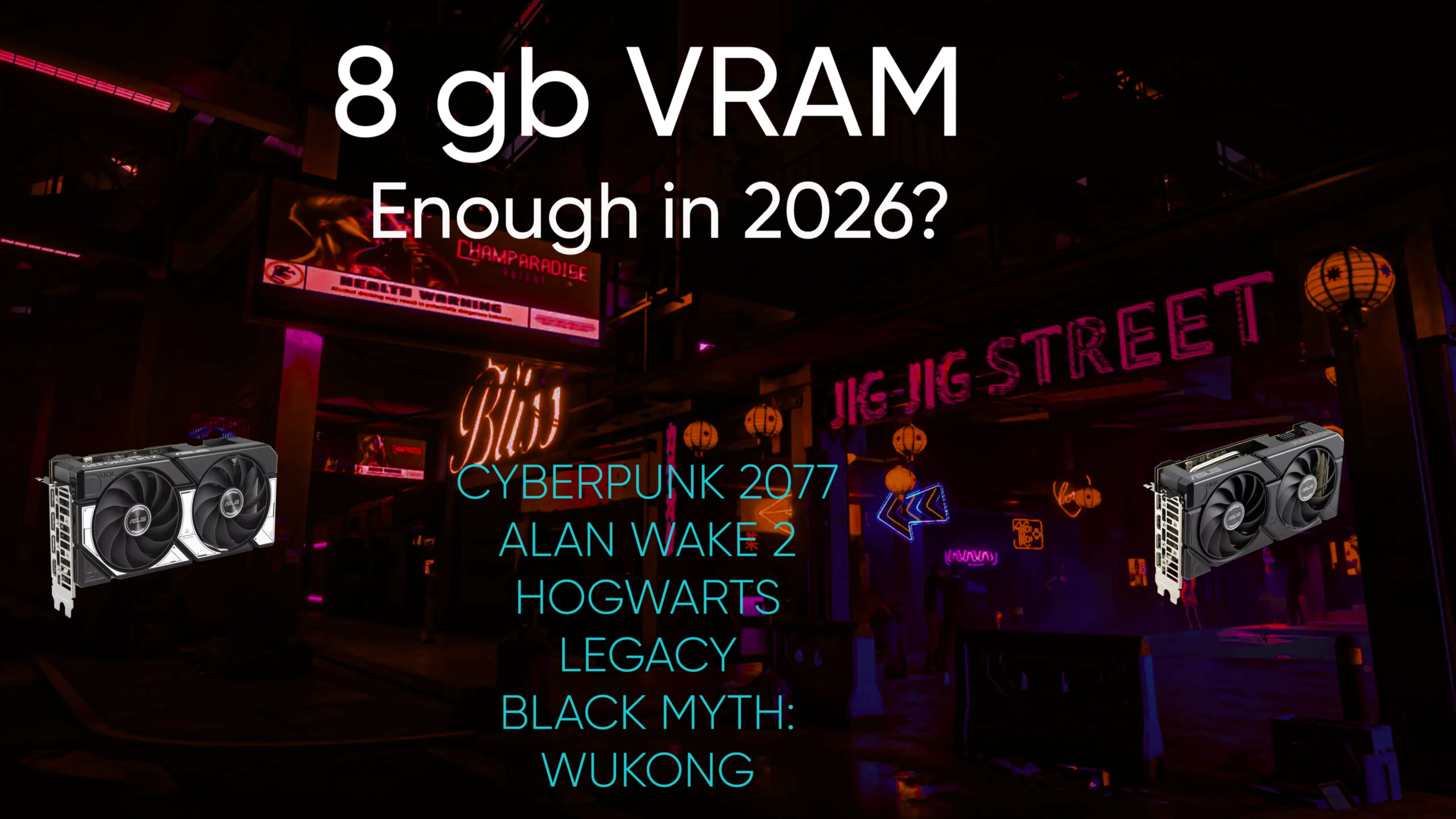
If you’ve spent any time looking for a graphics card recently, you’ve probably heard someone claim that 8GB VRAM is dead. Others insist it’s perfectly fine and that people are worrying about nothing.
So, is 8gb VRAM enough in 2026?
The answer depends on what games you play, what resolution you use, and how long you expect your graphics card to last. An RTX 4060 might handle one game without breaking a sweat, while another title can push an 8GB GPU much closer to its limits than many gamers expect.
That’s what makes this debate so confusing. 8GB VRAM isn’t completely obsolete in 2026, but it’s also no longer the comfortable recommendation it was just a few years ago.
Before you buy an 8GB graphics card, there are a few things you need to know.
Why VRAM Matters
VRAM is the memory built into your graphics card. Whenever you’re playing a game, your GPU uses that memory to store textures, data, shadows, geometry, and other things needed to render a scene.
The amount of VRAM a game needs depends on several factors. Higher resolution and higher texture quality, and features such as ray tracing can increase memory usage even further. Generally speaking, the higher you push graphical settings, the more VRAM a game is likely to consume.
When a game starts demanding more VRAM than your graphics card has available, problems start appearing. Sometimes that means lower performance, but not always. More commonly, you’ll notice texture pop-in, stuttering, inconsistent frame times, or having to lower settings that the GPU itself would otherwise be capable of handling.
A few years ago, 8GB was more than enough, but today the situation is less clear. Games are becoming more demanding, texture sizes keep growing, and developers are targeting newer hardware with larger memory buffers.
That’s why so many gamers are asking the same question in 2026: is 8GB still enough, or is it finally starting to show its age?
Is 8GB VRAM Enough for 1080p Gaming?
For most people, yes.
If you’re gaming at 1080p, an 8GB graphics card is still perfectly capable of handling most modern games. 8gb VRAM cards like the RTX 5060 and RX 7600 are still performing excellently. In fact, most games will still run perfectly fine at medium to high settings, and many can even handle ultra settings without issue. That’s why claims that “8GB is dead” are usually exaggerated
The problem is that we’re starting to see cracks.
A few years ago, buying an 8GB graphics card felt completely normal. Today, you’re seeing more and more games push close to that limit, especially when developers start throwing massive texture packs, ray tracing, and frame generation into the mix.
And then there are mods.
Anyone who’s spent time modding Skyrim, Minecraft, Fallout, or Cyberpunk already knows how quickly mods can eat through VRAM. You install a few high-resolution texture packs, add some visual overhauls, and suddenly the 8GB buffer doesn’t feel so comfortable anymore.
For 1080p specifically, It’s still enough for most people and most games. The issue is that it no longer feels generous. Every year, developers seem to find new ways to use more memory, while 8GB graphics cards are left with less room to breathe.
If all you care about is playing today’s games at 1080p, you’ll be fine but If you’re hoping your next GPU will still feel comfortable three or four years from now, the conversation becomes a little more complicated.
If you’re shopping for a budget 1080p graphics card, check out our Best 1080p GPUs for Gaming in 2026 recommendations
Is 8GB VRAM Enough for 1440p Gaming?
Unlike 1080p, whether 8GB VRAM is enough for 1440p depends heavily on the games you play and the settings you use. For instance, lets say we have two groups of gamers, first group are gamers who play maxed-out triple A games with ray tracing enabled. Second gamers spend most of their time in games like Counter-Strike 2, Valorant, Rocket League, or League of Legends.
For the second group, 8GB is still more than enough but for the first group 8gb just wont do the job for them anymore
Esports titles are generally far less demanding than modern AAA games, and many of them can run comfortably at 1440p without coming anywhere near the 8GB limit. If your gaming library consists mostly of competitive titles, VRAM probably isn’t something you need to worry about right now.
The story changes once you start loading up newer high end AAA releases.
The reality is that most 8GB graphics cards were designed primarily for 1080p gaming, not 1440p. They can certainly run games at 1440p, but that doesn’t mean they’re always comfortable doing so. Many modern AAA games can use 10GB or more of VRAM at 1440p when running higher texture settings, especially when ray tracing enters the picture.
That doesn’t mean every 8GB card suddenly becomes unusable. More often, it means compromises. Maybe you lower texture quality from Ultra to High. Maybe you disable ray tracing. Maybe you rely on upscaling a little more than you’d like.
The bigger issue is future-proofing.
If some games are already pushing beyond 8GB today, it’s not hard to imagine where things might be a few years from now. That’s why many gamers shopping for a 1440p graphics card in 2026 are looking at 12GB and 16GB options instead.
Therefore for 1440p resolution , 8gb VRAM may or may not be enough it just depends on what you want to play
If you’re shopping for a mid range 1440p graphics card, read our Best 1440p GPUs for Gaming in 2026
Is 8GB VRAM Enough for 4K Gaming?
At 4K, 8GB VRAM simply isn’t enough if your goal is to play modern AAA games at high or maximum settings. Many newer titles can already use more than 8GB of VRAM at 1440p, so moving up to 4K only makes the problem worse.
But 4K gaming is not impossible on an 8GB graphics card. Older games such as Elden Ring, GTA V, and many esports titles can still run perfectly well at 4K. Games like Valorant, League of Legends, Dota 2, Rocket League, and Counter-Strike 2 aren’t particularly demanding by modern standards and generally don’t need huge amounts of VRAM.
And again, 8GB graphics cards were never designed for 4K gaming in the first place. Cards like the RTX 5060 and RX 7600 are built with 1080p gaming in mind, with some 1440p capability depending on the game.
If you’re building a PC specifically for 4K gaming in 2026, an 8GB graphics card shouldn’t be on your shortlist.
Games Already Pushing Beyond 8GB VRAM
One of the biggest reasons the 8GB VRAM debate refuses to go away is that more and more games are capable of using more than 8GB of VRAM when settings are pushed to their limits.
That doesn’t automatically mean these games are unplayable on an 8GB graphics card and this is where a lot of gamers get confused.
A game might use 10GB, 11GB, or even 12GB of VRAM if it’s available, but that doesn’t mean it absolutely requires that amount to run. Modern games often adjust memory usage dynamically, stream assets in and out of memory, or allow players to lower texture settings when VRAM becomes a limitation.
In other words, seeing a game use more than 8GB VRAM doesn’t mean an RTX 5060 or RX 7600 cannot run that game, but it does mean that the safety margin is disappearing.
Here are some examples of such games:
| Game | Can Exceed 8GB VRAM at Maximum Settings? |
|---|---|
| Avatar: Frontiers of Pandora | Yes |
| Cyberpunk 2077 (RT Enabled) | Yes |
| Hogwarts Legacy | Yes |
| Resident Evil 4 Remake | Yes |
| Resident Evil Village | Yes |
| Resident Evil 2 Remake | Yes |
| Resident Evil 3 Remake | Yes |
| Far Cry 6 | Yes |
| Hitman 3 | Yes |
| Alan Wake 2 | Yes |
| Indiana Jones and the Great Circle | Yes |
| Black Myth: Wukong | Yes |
The important thing to notice is how many modern games are already appearing on this list. A few years ago, seeing a game use more than 8GB VRAM was unusual. Today, it’s becoming increasingly common once you enable maximum textures, ray tracing, or higher resolutions.
If today’s games are already comfortable using more than 8GB when given the opportunity, it’s reasonable to expect future titles to push even further. GTA 6 is a perfect example. Rockstar hasn’t revealed the PC requirements yet, but it’s difficult to imagine one of the most ambitious open-world games ever made demanding less memory than many modern AAA games already do today.
Should You Buy an 8GB Graphics Card in 2026?
If you’re buying a budget graphics card for 1080p gaming, an 8GB GPU is still a perfectly reasonable choice. Most games run well, esports titles aren’t a problem, and cards like the RTX 5060 and RX 7600 still have plenty of life left in them.
Where I start to hesitate is the mid-range market.
If I’m spending several hundred dollars on a graphics card in 2026, I’d rather have 12GB or 16GB of VRAM. Too many modern games are already pushing beyond 8GB for me to feel completely comfortable recommending it as a long-term investment.
That’s really the bottom line. 8GB isn’t dead, and for many gamers it’s still enough. But if your budget allows it, you should seriously consider more VRAM
Verdict: So, is 8GB VRAM enough in 2026?
For most 1080p gamers, yes.
Despite all the doomposting online, 8GB graphics cards can still handle the vast majority of modern games, especially if you’re willing to use high settings instead of blindly cranking everything to Ultra.
The bigger concern isn’t today’s games. It’s tomorrow’s.
Newer modern games are already capable of using more than 8GB of VRAM, and that is not gonna change anytime soon. While 8GB GPUs aren’t obsolete, they no longer offer the same comfort and headroom they did a few years ago.
If you’re shopping on a budget, an 8GB graphics card can still be a smart purchase. If you’re buying a GPU that you plan to keep for years, however, 12GB or 16GB is becoming the safer bet.
Frequently Asked Questions
Is 8GB VRAM enough for gaming in 2026?
Yes. For most 1080p gamers, 8GB VRAM is still enough in 2026. However, newer AAA games are becoming increasingly demanding, especially at higher settings and resolutions.
Is 8GB VRAM enough for 1440p gaming?
It depends on the game. Esports titles and older games generally run without issue, but many modern AAA releases are beginning to push beyond the 8GB limit at higher settings.
Is 8GB VRAM enough for 4K gaming?
Not really. Older games and esports titles can still run at 4K, but most modern AAA games are better suited to graphics cards with more than 8GB of VRAM.
What happens when a game uses more than 8GB VRAM?
The game usually doesn’t stop working. Instead, you may experience stuttering, texture pop-in, inconsistent frame times, or the need to lower texture quality settings.
Is 12GB VRAM enough in 2026?
For most gamers, yes. A 12GB graphics card provides significantly more headroom than 8GB and is generally a safer choice for long-term 1440p gaming.
Is 16GB VRAM overkill?
For many current games, yes. However, the extra memory can help future-proof a graphics card and reduce the chances of VRAM becoming a limitation later on.
Will GTA 6 need more than 8GB VRAM?
Rockstar hasn’t released the PC requirements yet, so nobody knows for certain. However, considering the direction modern AAA games are heading, it wouldn’t be surprising if GTA 6 benefited from more than 8GB of VRAM at higher settings.
Should I avoid buying an 8GB graphics card?
Not necessarily. If you’re gaming at 1080p and shopping on a budget, an 8GB GPU can still be a good purchase. The biggest concern is long-term ownership rather than current performance.

Leave a Reply