
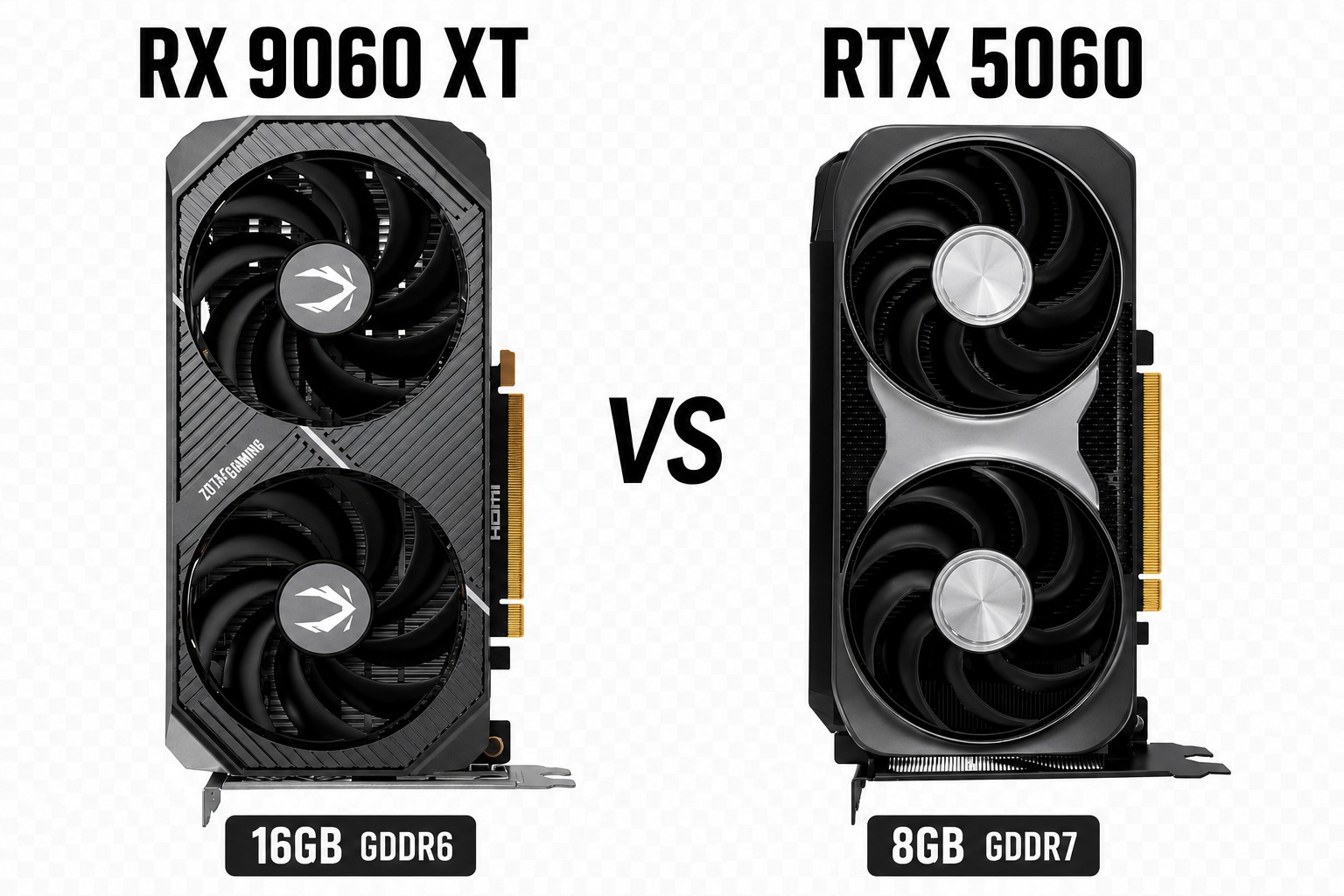
AMD RX 9060 XT vs Nvidia RTX 5060. Is 16GB VRAM worth it over DLSS 4 and ray tracing? We break down 1080p and 1440p gaming performance benchmarks
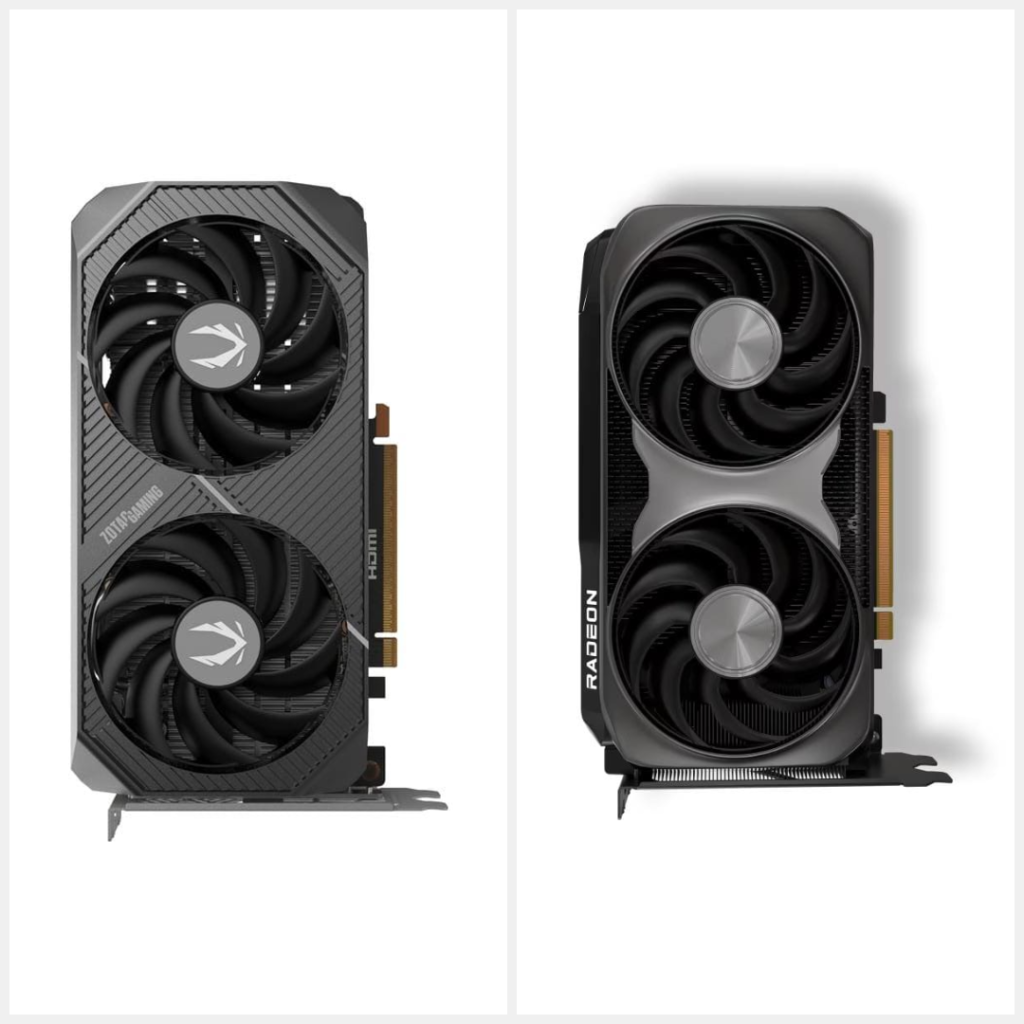
At first, the RX 9060 XT vs RTX 5060 comparison sounds pretty simple. Both are mid-range GPUs aimed at 1080p and 1440p gaming, and both launched close enough in price that people immediately started comparing them.
But once benchmarks started showing up, the difference in approach became obvious very quickly.
The RTX 5060 is built around Nvidia’s Blackwell architecture and leans heavily into features like DLSS 4, Multi Frame Generation, ray tracing, and Nvidia’s software ecosystem. The raw FPS isnt bad at all, but Nvidia clearly focused more on AI-assisted performance and software features this generation.
AMD pushed the RX 9060 XT in a different direction. Built on the newer RDNA 4 architecture, the card focuses way more on raw gaming performance and VRAM capacity. The 16GB VRAM is one of the biggest talking points in the whole RX 9060 XT vs RTX 5060 discussion because Nvidia still launched the RTX 5060 with only 8GB at around $299, while the 16GB RX 9060 XT sits closer to $349.
And the VRAM issue isnt just internet arguing either. Games like Hogwarts Legacy, Horizon Forbidden West, and newer Call of Duty titles can already go past 8GB usage with higher textures enabled. Once VRAM fills up, you start getting stutters, texture pop-in, weird frame pacing, stuff loading late — the game still runs, but it stops feeling smooth.
Nvidia still has advantages though. DLSS 4 looks cleaner than FSR 4 in alot of games, ray tracing performance is stronger, and Nvidia cards are still better for things like Blender, AI tools, and content creation workloads.
Check out our full AMD Radeon RX 9060 XT standalone review
Check out our full Nvidia RTX 5060 standalone review
Specs Comparison
| Specification | AMD Radeon RX 9060 XT | NVIDIA GeForce RTX 5060 |
| Architecture | RDNA 4 | Blackwell |
| VRAM | 16GB GDDR6 | 8GB GDDR7 |
| Upscaling | FSR 4 (AI-driven) | DLSS 4 |
| Frame Generation | FSR 4 Frame Gen / AFMF | Multi Frame Generation |
| TBP (Power Draw) | ~160W | ~145W |
| Ray Tracing | Standard RT Support | Superior RT Performance |
| Launch Price | ~$349 | ~$299 |
| Main Strength | Higher Raw FPS + 16GB VRAM | Premium Features + Heavy Ray Tracing |
RDNA 4 vs Blackwell (Architecture)
Blackwell leans heavily into AI features and software tech. Thats why Nvidia still leads in things like DLSS 4, Multi Frame Generation, ray tracing, Blender rendering, and AI workloads. The RTX 5060 feels like a card designed around features just as much as gaming performance itself.
RDNA 4 feels alot more gaming-focused. AMD improved raster performance quite a bit, ray tracing performance is noticeably better than older Radeon cards, and the efficiency is surprisingly good too considering the FPS this card pushes. Features like FSR 4, HYPR-RX, AFMF2, and Anti-Lag 2 are also part of the package now, so AMD definitely isnt ignoring software anymore either.
In regular gaming without heavy ray tracing, the RX 9060 XT just does better in raw FPS. But once heavier RT workloads or AI-related tasks gets involved, Blackwell usually pulls ahead again.
VRAM: 8GB GDDR7 vs. 16GB GDDR6
This is the biggest reason the whole RX 9060 XT vs RTX 5060 debate became so huge this quickly. The RTX 5060 comes with 8GB GDDR7, while the RX 9060 XT ships with 16GB GDDR6.
Now to be fair, GDDR7 is faster than GDDR6. Nvidia’s memory has noticeably higher bandwidth, which does help in some situations. So this isnt just “16 beats 8” and thats it. The RTX 5060 does benefit from the newer memory technology.
But the bigger problem is capacity. Modern games are starting to use alot more VRAM now, specially once you enable higher textures or move to 1440p. Games like Hogwarts Legacy, Horizon Forbidden West, Last of Us , and newer Call of Duty titles can already go past 8GB usage pretty easily.
And once VRAM fills up, the problems get annoying fast. You start seeing stutters, inconsistent frame pacing, textures loading late, blurry assets, random hitching during movement, stuff like that. Sometimes the FPS still looks okay, but the game itself stops feeling smooth.
The RX 9060 XT having 16GB removes alot of that pressure completely. Thats probably the biggest reason many people started seeing it as the more future-proof card, specially for newer AAA games over the next few years.
FSR 4 VS DLSS 4 (Upscaling and Frame Generation)
This is the biggest advantage Nvidia has right now. The RTX 5060 supports DLSS 4 with Multi Frame Generation, while the RX 9060 XT uses FSR 4 along with AFMF and HYPR-RX.
In terms of image quality, DLSS still looks cleaner in alot of games. Small details like hair, fences, particles, shadows, stuff moving quickly across the screen — Nvidia usually handles those situations better. One reason for that is DLSS 4 now uses newer Vision Transformer AI models, which is actually the same type of AI architecture used in things like ChatGPT and Gemini. It tracks image data across longer time periods, which helps alot during fast movement or camera panning.
AMD changed alot with FSR 4 too though. Older FSR versions mostly relied on hand-coded algorithms, but FSR 4 finally became a true AI upscaler using RDNA 4’s dedicated Matrix Cores. Thats a huge reason why particle ghosting and blurry image issues improved so much compared to FSR 3
Frame Generation is another difference. Nvidia’s Multi Frame Generation feels more polished overall, and Blackwell GPUs even include a dedicated hardware “flip-metering” system to help pace generated frames properly and reduce hidden stutters. AMD’s AFMF can still boost FPS alot, but results depend more on the game
One really cool thing AMD added though is driver-level FSR upgrading. RDNA 4 cards can detect some older FSR 3.1 games and automatically upgrade them to FSR 4 through the driver itself, even if the developer stopped updating the game years ago.
Check out our full Nvidia RTX 5060 standalone review
Power Efficiency
Both cards are actually very efficient for mid-range GPUs. The RTX 5060 usually pulls around 130W–150W during gaming, while the RX 9060 XT sits closer to 160W–180W depending on the game and model.
Nvidia still has the efficiency advantage overall, so the RTX 5060 runs a bit cooler and uses less power. But RDNA 4 improved AMD’s efficiency alot compared to older Radeon generations.
For PSU requirements, the RTX 5060 is generally fine with a quality 450W–550W PSU, while the RX 9060 XT is more comfortable on a 550W–650W power supply. Both cards mostly use standard 8-pin PCIe connectors, although some higher-end RX 9060 XT models can use dual 8-pin setups
Ray Tracing
Ray tracing is still one of Nvidia’s biggest advantages in the RX 9060 XT vs RTX 5060 comparison. The RTX 5060 handles heavier ray tracing settings noticeably better, specially in games like Cyberpunk 2077, Alan Wake 2, or Portal RTX where ray tracing can absolutely destroy FPS in 1080p
AMD improved ray tracing alot with RDNA 4 though. RDNA 4 moved to a newer BVH8 traversal engine and added something called Oriented Bounding Boxes. In simple terms, the GPU can now calculate 3D objects in a smarter and more flexible way instead of using rigid box structures like older Radeon cards did. That reduces memory overhead alot, which is a big reason the RX 9060 XT handles medium RT settings much better than older AMD GPUs.
But Nvidia still pulls ahead once very heavy ray tracing or full path tracing gets involved. Blackwell introduced newer ray tracing hardware for handling things like complex geometry, curved objects, hair, foliage, and dense scene detail much more efficiently. Thats why games with heavy path tracing usually run noticeably better on the RTX 5060 even if the RX 9060 XT is faster in normal raster gaming.
This is also one of the few situations where the RTX 5060 can end up getting higher FPS despite being weaker in traditional gaming performance overall.
Pricing
The RTX 5060 is currently around 355$ in the market , while the RX 9060 XT 16GB is more costy and sits closer to $450 depending on the brand and cooler design. Depending on the model, there can be around only $50-$100 price difference, which is a huge reason this comparison became so popular this quickly.
AMD also has a cheaper RX 9060 XT 8GB version, which sits closer to the RTX 5060 in pricing. But most people are paying attention to the 16GB model because thats the version that really stands out in the mid-range market right now.
Some cheaper dual-fan models stay close to MSRP, while premium triple-fan cards from Sapphire, XFX, or ASUS can cost a bit more on both sides.
Check RX 9060 XT price on Amazon
Check RTX 5060 price on Amazon
1080p Gaming
At normal 1080p gaming, both of these cards are very strong already. Esports games run at crazy high FPS on both GPUs, and most AAA games stay smooth at high or ultra settings too.
The RX 9060 XT clearly pushes more FPS in most normal gaming situations. Thats specially noticeable in heavier AAA games where the extra VRAM and stronger raster performance start helping alot. Games like Hogwarts Legacy, Starfield, and newer Call of Duty titles already use quite alot of VRAM with higher textures enabled, and thats where the RX card starts feeling much more comfortable
| Game | RX 9060 XT | RTX 5060 |
|---|---|---|
| Valorant | 300–400 FPS | 280–380 FPS |
| CS2 | 240–320 FPS | 230–310 FPS |
| Fortnite | 160–220 FPS | 150–210 FPS |
| Apex Legends | 190–260 FPS | 180–240 FPS |
| Cyberpunk 2077 | 100–120 FPS | 84–105 FPS |
| Hogwarts Legacy | 90–110 FPS | 76–95 FPS |
| Warzone | 130–160 FPS | 115–145 FPS |
| Red Dead Redemption 2 | 115–135 FPS | 96–118 FPS |
| Spider-Man 2 | 110–140 FPS | 98–125 FPS |
| Starfield | 85–105 FPS | 70–90 FPS |
| GTA V Enhanced | 180–240 FPS | 170–230 FPS |
| Forza Horizon 5 | 150–190 FPS | 135–175 FPS |
Note: Esports titles are heavily CPU dependent. Results can vary alot depending on processor and RAM setup.
One interesting thing is that both cards actually use a relatively narrow 128-bit memory bus, which is mainly why they are considered 1080p-focused GPUs instead of true high-end 4K cards. But both companies solved this limitation very differently.
The RTX 5060 uses much faster GDDR7 memory running around 28 Gbps, which gives it huge raw bandwidth numbers. AMD went another route with the RX 9060 XT by using 3rd-gen Infinity Cache. At 1080p, alot of game data can stay directly inside that fast on-chip cache instead of constantly going back to slower VRAM, which helps performance alot.
The RX 9060 XT also boosts to extremely high clock speeds — around 3.1 GHz out of the box. Thats one of the reasons the card flies in esports games like Valorant or CS2 without needing upscaling tricks.
VRAM usage is another big difference. Even at 1080p, newer games like Hogwarts Legacy or Starfield can already use more than 8GB VRAM with ultra textures enabled. Once the RTX 5060 fills up its memory, it sometimes has to start swapping texture data through the PCIe bus into system RAM, which can cause stutters or rough frametimes. The RX 9060 XT’s 16GB buffer avoids most of that completely.
There’s also a small PCIe difference people dont talk about enough. The RTX 5060 uses PCIe Gen 5 x8, while the RX 9060 XT keeps a full x16 connection. On newer motherboards this doesnt matter much, but on older PCIe Gen 3 systems, the RTX 5060 can sometimes lose a bit of smoothness in heavier games because of reduced bandwidth.
Ray tracing changes the situation abit though. In normal raster gaming, the RX 9060 XT is usually faster. But once heavier Ray tracing or path tracing settings get enabled, the RTX 5060 can actually pull ahead in some games because Nvidia’s RT hardware handle those workloads much better.
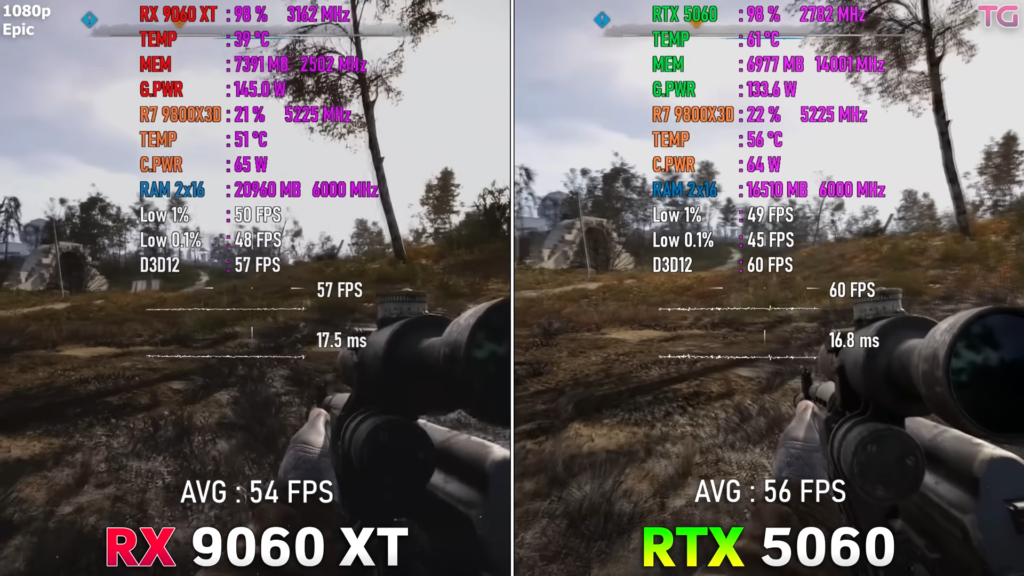
Image source: Testing Games (YouTube)
As you can see above, Stalker 2 is one of the few games where the RTX 5060 actually performs slightly better despite the RX 9060 XT usually winning in raw raster performance. Thats mostly because Unreal Engine 5 relies heavily on advanced lighting, geometry, and RT-related rendering techniques, which Nvidia hardware currently handles better overall.
Also read : Best GPUs for 1080p gaming in 2026
1440p Gaming
This is where the RX 9060 XT starts separating itself more clearly from the RTX 5060 perfomance wise. At 1080p both cards are strong, but once you move up to 1440p, the extra VRAM and stronger raster performance on the AMD card starts helping alot more.
Also read: Best 1440p GPUs for Gaming in 2026
| Game | RX 9060 XT | RTX 5060 |
|---|---|---|
| Forza Horizon 5 | 117 FPS | 92 FPS |
| Cyberpunk 2077 | 78 FPS | 65 FPS |
| Hogwarts Legacy | 72 FPS | 58 FPS |
| Warzone | 108 FPS | 91 FPS |
| Red Dead Redemption 2 | 92 FPS | 76 FPS |
| Spider-Man 2 | 86 FPS | 72 FPS |
| Starfield | 67 FPS | 54 FPS |
| Horizon Forbidden West | 81 FPS | 66 FPS |
The biggest thing here is the VRAM situation. At 1440p, newer AAA games start using alot more memory, specially with ultra textures enabled. Thats where the RX 9060 XT’s 16GB buffer starts feeling way more comfortable.
The RTX 5060 can still do 1440p gaming, but it feels more like a “medium-high settings with DLSS” type of experience sometimes. The RX 9060 XT handles native 1440p alot better overall and doesnt run into VRAM pressure nearly as quickly.
And unlike older Radeon cards, RDNA 4 actually handles 1440p surprisingly well efficiency-wise too. The card doesnt suddenly become some giant power-hungry monster once the resolution increases.
Ray tracing still changes things though, in heavier ray tracing games, the RTX 5060 can sometimes close the gap or even pull ahead because DLSS 4 and Nvidia’s RT hardware are still stronger overall. But for normal raster gaming at 1440p, the RX 9060 XT simply feels more comfortable and more future-proof.
Check out our full AMD Radeon RX 9060 XT standalone review
Who Should Buy Which?
I think this decision comes down to one question: what annoys you more?
If the answer is “running out of VRAM,” then I’d go with the RX 9060 XT. Modern games aren’t getting any lighter, and 16GB gives you a lot more room to work with in demanding titles. It’s also the card I’d pick for someone planning to keep their GPU for several years or spend a lot of time gaming at 1440p.
If the answer is “missing out on Nvidia features,” then the RTX 5060 is the better fit. DLSS, Frame Generation, ray tracing, Blender support, streaming tools, AI workloads—Nvidia still has advantages that extend beyond gaming benchmarks. For some people that’s worth more than a few extra frames per second.
Neither choice is wrong.
The RX 9060 XT is the card I’d buy for performance. The RTX 5060 is the card I’d buy for features.
Final Verdict
After spending time looking through benchmarks, newer games, and all the feature differences, the RX 9060 XT vs RTX 5060 comparison honestly feels alot less balanced than people expected at first.
The RTX 5060 is still a very solid GPU. DLSS 4 is better than FSR 4 overall, ray tracing performance is noticeably stronger, and Nvidia still wins pretty comfortably in AI workloads, Blender, and content creation stuff. For people who care alot about those features, the RTX 5060 still makes sense.
But purely for gaming value, the RX 9060 XT is just better. More FPS in most games, 16GB VRAM, stronger 1440p performance, and fewer worries about memory limits in newer games. Thats the biggest reason so many people started recommending it almost immediately after launch.
The RTX 5060 feels more feature-focused. The RX 9060 XT feels more like perfomance focused.
Check RX 9060 XT current price on Amazon
Check RTX 5060 current price on Amazon
Frequently Asked Questions
Is the RX 9060 XT better than the RTX 5060?
For normal gaming performance, yes in most cases. The RX 9060 XT usually gets higher FPS in raster gaming and the 16GB VRAM helps alot in newer AAA games. The RTX 5060 still wins in ray tracing, DLSS 4 quality, and AI-related workloads though
Is 8GB VRAM enough in 2026?
For lighter games and esports titles, yes its still mostly fine. But newer AAA games are already starting to push past 8GB pretty easily with ultra textures enabled, specially at 1440p. Thats why alot of people are worried about long-term use on the RTX 5060.
Is the RX 9060 XT actually good for 1440p gaming?
Yeah, surprisingly good honestly. The extra VRAM and stronger raster performance help alot once you move beyond 1080p. It still isnt some ultra high-end 4K card or anything, but for normal 1440p gaming the RX 9060 XT performs very well.
Does DLSS 4 look better than FSR 4?
In most games, yes. FSR 4 improved alot compared to older versions, but DLSS 4 still handles movement, small details, and image stability better overall. Nvidia’s Frame Generation also feels slightly more polished right now.
Why does the RTX 5060 sometimes perform better in UE5 games?
Some Unreal Engine 5 games rely heavily on advanced lighting, geometry, and RT-related rendering techniques. Games like Stalker 2 can favor Nvidia hardware because Blackwell handles those workloads more efficiently, specially once DLSS and ray tracing features get involved.
Which card is better if I want to stream on Twitch or edit videos?
The RTX 5060 is usually the better choice for streaming and content creation. Nvidia’s NVENC encoder is still widely preferred for Twitch streaming, and alot of editing apps like Premiere Pro, DaVinci Resolve, Blender, and AI tools tend to work better on Nvidia GPUs overall.
Is the 16GB version of the RX 9060 XT worth the extra $50 over the 8GB version?
Yes for most people, the whole reason the RX 9060 XT became so popular is because of the 16GB VRAM model. The cheaper 8GB version still works fine for normal 1080p gaming, but the 16GB model is definitely the more interesting option overall.
Also Read
RTX 5060 Review: Is it still worth buying in 2026?
RTX 5070 vs RTX 4070: Should you upgrade?
RTX 5070 ti vs RTX 5070: Worth the Extra Money?
RTX 5060 vs RTX 4060: Is it worth the upgrade?
RTX 4070 Ti SUPER vs RTX 5070: Which offers better value?
RTX 5060 ti vs RX 9060 XT: Is NVIDIA worth paying $100 more?
RTX 4060 vs RX 7600: Which is the better buy in 2026?
Is the RTX 5060 Ti good for 1440p gaming
Intel Arc B580 vs RTX 5060: Don’t buy until you read this
RX 9060 XT Review: The Best GPU for 1080p Gaming Right Now?
Best GPUs for 1080p gaming in 2026
RX 9070 XT Review: Is it really future proof?
RX 9070 review: Is it REALLY worth your money?
Best 1440p GPUs for Gaming in 2026
RTX 5070 review: The best 1440p GPU in 2026?
RX 7600 Review: Is it still worth buying in 2026
Is RTX 4060 it still worth buying in 2026?
RTX 4070 review: Is it worth buying in 2026?

Leave a Reply