
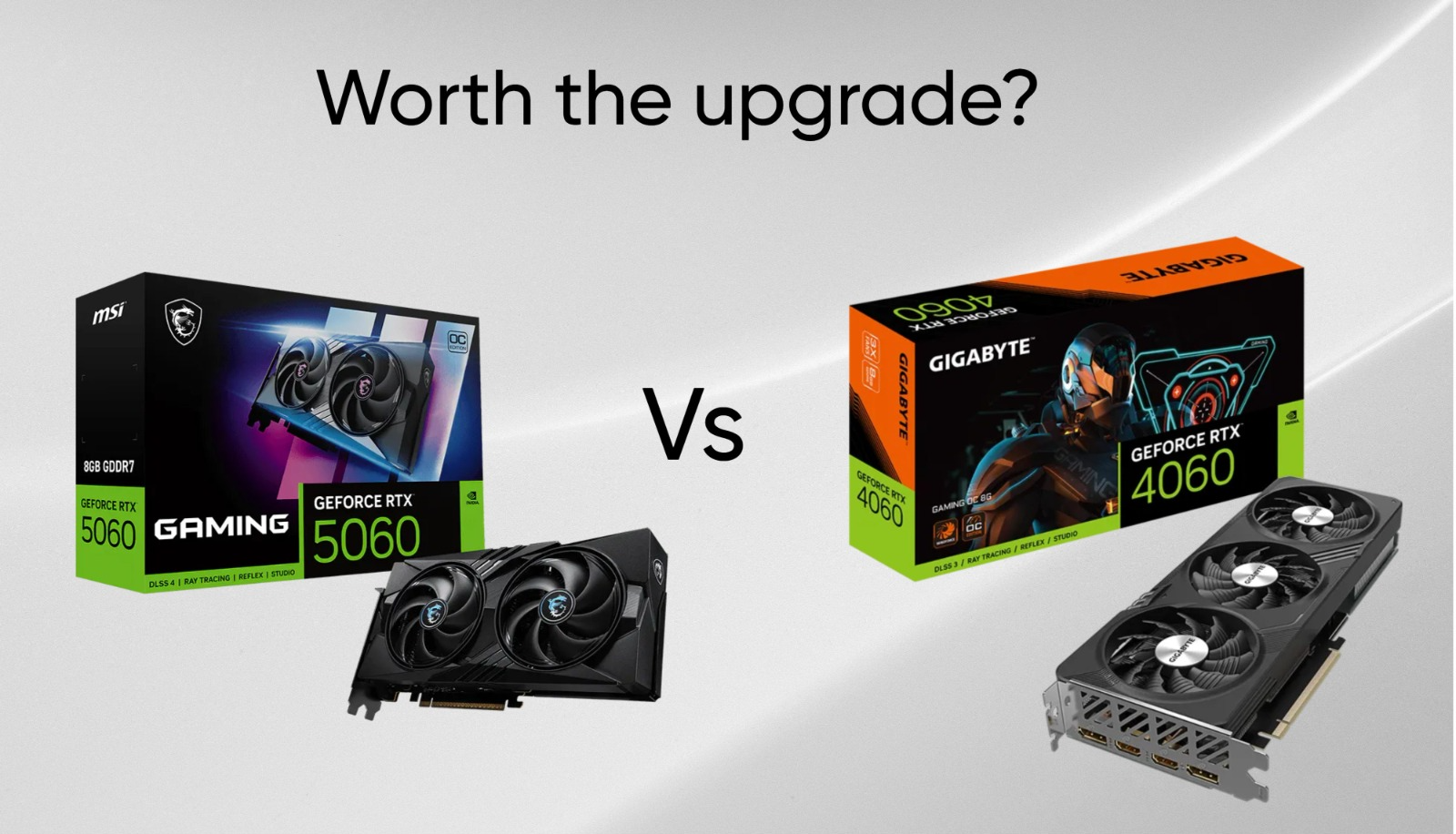
The RTX 5060 is faster, newer, and packed with better features—but it also costs around $30-50 more than the RTX 4060. Is it money well spent, or is the older card still the better value? Let’s break it down.
Check current RTX 5060 prices on Amazon Check current RTX 4060 prices on Amazon
RTX 5060 vs RTX 4060 Specifications
| Specification | RTX 5060 | RTX 4060 |
|---|---|---|
| Architecture | Blackwell | Ada Lovelace |
| CUDA Cores | 3,840 | 3,072 |
| Ray Tracing Cores | 4th Gen RT Cores | 3rd Gen RT Cores |
| Tensor Cores | 5th Gen Tensor Cores | 4th Gen Tensor Cores |
| Base Clock | 2.28 GHz | 1.83 GHz |
| Boost Clock | 2.50 GHz | 2.46 GHz |
| VRAM | 8GB GDDR7 | 8GB GDDR6 |
| Memory Bus | 128-bit | 128-bit |
| Memory Speed | 28 Gbps | 17 Gbps |
| Memory Bandwidth | 448 GB/s | 272 GB/s |
| L2 Cache | 24MB | 24MB |
| PCIe Interface | PCIe 5.0 x8 | PCIe 4.0 x8 |
| Power Consumption (TGP) | 145W | 115W |
| Recommended PSU | 550W | 550W |
| DLSS Support | DLSS 4 + Multi Frame Generation | DLSS 3 + Frame Generation |
| AV1 Encoding | Yes | Yes |
| Launch MSRP | $299 | $299 |
| Launch Date | May 2025 | June 2023 |
The RTX 5060 isn’t just a minor update over the RTX 4060. It packs more CUDA cores, a newer Blackwell architecture, faster GDDR7 memory, improved ray tracing hardware, and the latest Tensor cores. The biggest hardware upgrade is the switch to GDDR7, which boosts memory bandwidth from 272 GB/s to 448 GB/s without changing the 128-bit memory bus.
The RTX 5060 is around 20% to 30% faster than the RTX 4060 in traditional rasterized gaming, making it the stronger choice for both 1080p and 1440p gaming. The performance gap grows even further in ray-traced games, where the combination of Blackwell’s architectural improvements and DLSS 4 Multi Frame Generation allows the RTX 5060 to deliver substantially higher frame rates in supported titles.
That said, both GPUs still ship with 8GB of VRAM. For 1080p gaming, that’s generally enough today, but it also means the RTX 5060 doesn’t completely solve one of the biggest criticisms of the RTX 4060. If you were expecting more memory, you’ll be disappointed.
NVIDIA has introduced DLSS 4 with Multi Frame Generation on the RTX 5060, giving it access to newer AI-powered features that the RTX 4060 simply doesn’t support. Those additions won’t show up in a specs table, but they can make a noticeable difference in supported games.
Ray Tracing Performance
Ray tracing is one of the biggest reasons to consider spending the extra $50 on the RTX 5060. The raw RT performance isn’t dramatically different, but the software experience is.
The biggest upgrade is Multi Frame Generation. While both GPUs support the latest DLSS Super Resolution models, only the RTX 5060 can use DLSS 4 Multi Frame Generation. In games that support it, that alone can produce a much larger performance boost than the hardware improvements themselves.
Take Cyberpunk 2077 as an example. With heavy ray tracing enabled, the RTX 4060 often relies on DLSS and standard Frame Generation just to stay comfortably above 60 FPS. The RTX 5060 has access to Multi Frame Generation, giving it considerably more headroom without forcing you to lower settings.
That doesn’t mean every game will suddenly run twice as fast. Multi Frame Generation only works in supported titles, and not everyone likes using frame generation technologies. But if you play modern AAA games with ray tracing enabled, it’s one of the biggest differences between these two GPUs—and something the RTX 4060 simply can’t match.
Power Efficiency
The RTX 4060 remains one of NVIDIA’s most power-efficient graphics cards. Despite delivering solid 1080p gaming performance, it has a 115W TGP and typically consumes around 110W during gaming. It also works comfortably with a 450W to 550W PSU, making it a great option for compact builds or older systems with lower-wattage power supplies.
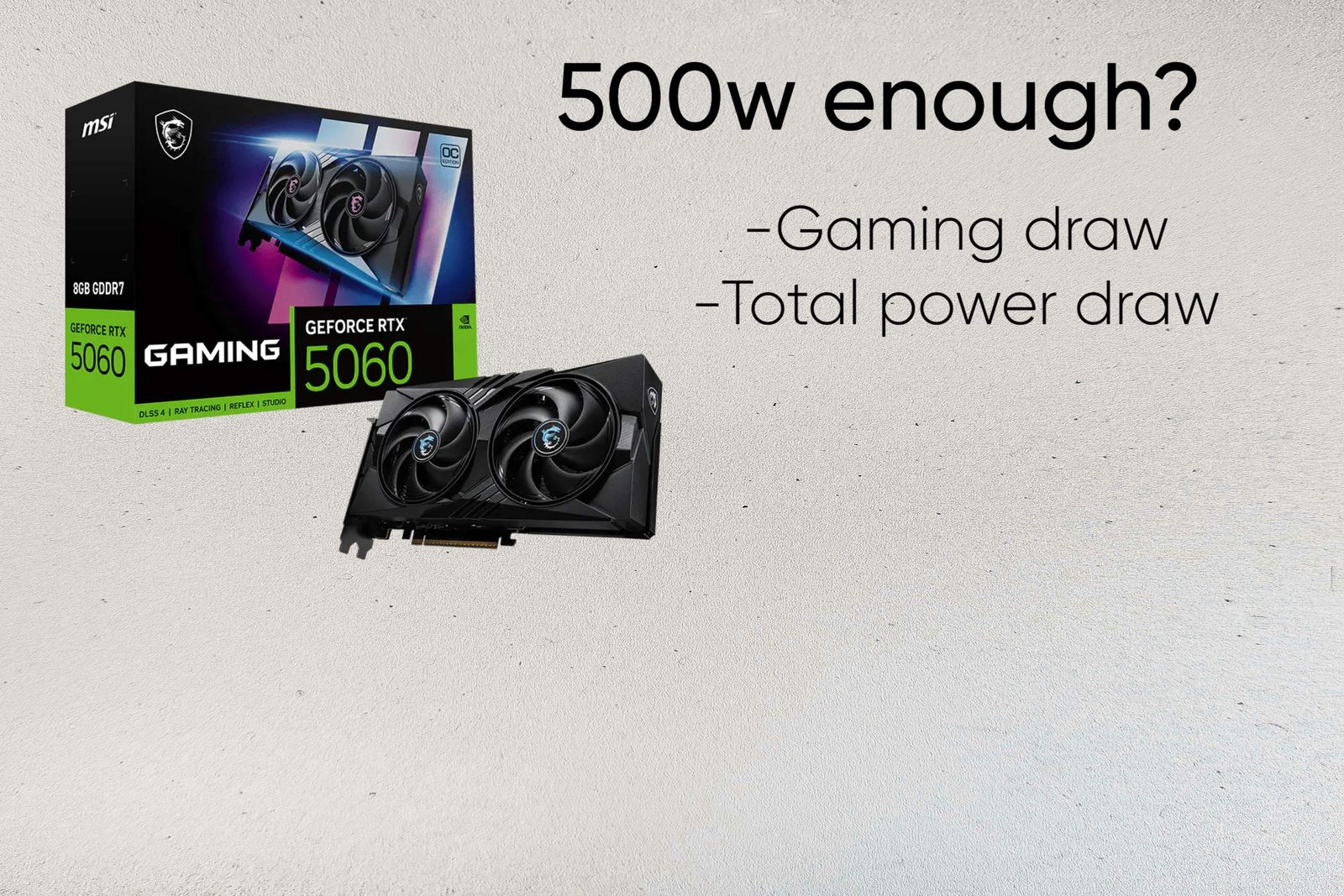
The RTX 5060 draws more power, with a 145W TGP (some factory-overclocked models can reach 155W). Even so, its average gaming power consumption is only around 106W, showing just how efficient the Blackwell architecture is under real-world workloads. NVIDIA recommends a 550W PSU, although some premium models may suggest 650W depending on their factory overclock and cooling design.
While the RTX 5060 requires a slightly beefier power supply on paper, the increase is relatively small considering the extra performance it delivers. If you’re building a new PC with a modern 550W or higher PSU, power consumption shouldn’t be a deciding factor. However, if you’re upgrading an older system with a 450W power supply, the RTX 4060 is the easier drop-in upgrade without needing to replace your PSU.
Pricing
At launch, both the RTX 5060 and RTX 4060 carried the same $299 MSRP. In reality, though, that’s rarely what you’ll pay. Most RTX 4060 models now sell for around $300–350, while the newer RTX 5060 typically starts at $350 and goes up depending on the model and cooling solution.
Check current RTX 5060 prices on Amazon
Check current RTX 4060 prices on Amazon
1080p Gaming Performance
The RTX 5060 delivers a noticeable improvement over the RTX 4060 at 1080p, with most modern games running 15% to 20% faster at native settings. The jump comes from NVIDIA’s new Blackwell architecture, a higher CUDA core count, and much faster GDDR7 memory, giving the newer card more headroom in demanding titles.
The difference is easy to spot across a wide range of games. In Cyberpunk 2077, the RTX 5060 pushes around 105 FPS compared to 89 FPS on the RTX 4060. Black Myth: Wukong improves from 52 FPS to 63 FPS, while Call of Duty: Black Ops 6, Hogwarts Legacy, and Forza Horizon 5 all see similar gains. If you’re aiming for a high-refresh-rate 1080p monitor, those extra frames make gameplay noticeably smoother.
Although both GPUs are limited to 8GB of VRAM, the RTX 5060 upgrades to 28 Gbps GDDR7 memory, increasing memory bandwidth from 272 GB/s to 448 GB/s. That doesn’t magically solve every VRAM limitation, but it does help with asset streaming, frame pacing, and 1% lows in games that constantly load textures as you move through the world.
For existing RTX 4060 owners, a 15% to 20% boost in traditional gaming alone probably isn’t enough to justify upgrading. But if you’re building a new PC or moving up from an older GPU like the GTX 1660, RTX 2060, or RTX 3060, the RTX 5060 is the better long-term choice. It delivers higher frame rates today while also giving you access to newer features like DLSS 4 Multi Frame Generation for supported games.
| Game | RTX 5060 | RTX 4060 | Settings |
|---|---|---|---|
| Cyberpunk 2077 | 73 FPS | 61 FPS | Highest / Native |
| Black Myth: Wukong | 40 FPS | 32 FPS | Highest / Native |
| Call of Duty: Black Ops 6 | 75 FPS | 68 FPS | Highest / Native |
| Hogwarts Legacy | 75 FPS | 60 FPS | Highest / Native |
| Forza Horizon 5 | 125 FPS | 100 FPS | Highest / Native |
| Starfield | 66 FPS | 55 FPS | Highest / Native |
| Assassin’s Creed Shadows | 57 FPS | 48 FPS | Highest / Native |
| Marvel’s Spider-Man 2 | 80 FPS | 67 FPS | Highest / Native |
All benchmarks were tested using an AMD Ryzen 7 9800X3D, 32GB DDR5-6000 memory, and Windows 11 24H2. Games were run at 1920×1080 using their highest native graphics preset, with ray tracing, DLSS/FSR/XeSS, and Frame Generation disabled unless otherwise stated.
Also read: Best GPUs for 1080p gaming in 2026
1440p Gaming Performance
This is where the RTX 5060 starts justifying its higher price.
At 1080p, the extra performance is nice to have. At 1440p, it becomes much easier to appreciate because you’re already asking more from the GPU. Games that struggle to stay above 50 FPS on the RTX 4060 are much closer to the 60 FPS mark on the RTX 5060, and that changes how they actually feel to play.
The difference is easy to see in the benchmarks. Cyberpunk 2077 climbs from 42 FPS to 51 FPS, Hogwarts Legacy goes from 45 FPS to 55 FPS, and Starfield moves from 39 FPS to 48 FPS. None of those numbers look dramatic on paper, but once you’re hovering around 50–60 FPS, another eight or ten frames can be the difference between leaving the settings alone and immediately opening the graphics menu.
The faster GDDR7 memory deserves some credit here too. NVIDIA didn’t increase the VRAM capacity—it still sits at 8GB—but memory bandwidth jumps from 272 GB/s to 448 GB/s. That doesn’t magically fix the VRAM problem, but it does help the RTX 5060 keep up in games that constantly stream assets.
Let’s be honest, though: 8GB is still the elephant in the room. Games like The Last of Us Part I and Spider-Man 2 can chew through that memory at 1440p if you insist on ultra textures. When that happens, neither card escapes unscathed. You’ll still end up dropping texture quality, regardless of which one you buy.
If you’re buying a graphics card mainly for 1440p, the RTX 5060 makes a lot more sense. The extra performance isn’t just another number on a chart—it gives you enough headroom that you’re less likely to be tweaking settings every time a new AAA game comes out.
Also read: Best GPUs for 1440p gaming
RTX 5060 vs RTX 4060: Which Should You Buy?
If you’re buying a graphics card today, I’d spend the extra $30-$50 and get the RTX 5060. The performance jump is large enough that you won’t be wondering six months from now if you should have bought the newer card instead. Higher frame rates, much faster GDDR7 memory, stronger ray tracing, and DLSS 4 Multi Frame Generation make it the better value despite the higher price.
That doesn’t mean everyone should rush out and upgrade.
If you’re already using an RTX 4060, I’d save the money. A 20–30% performance boost sounds great on paper, but it’s not the kind of jump that transforms your gaming experience. The RTX 4060 is still a capable 1080p graphics card, and spending another $350 for one generation of improvement is hard to justify. I’d rather keep the 4060 for another generation and wait for a bigger leap—or, hopefully, a card with more than 8GB of VRAM.
The RTX 5060 isn’t perfect either. NVIDIA fixed a lot of what held the RTX 4060 back, but it left the biggest complaint untouched. In 2026, 8GB of VRAM still feels restrictive, especially if you spend a lot of time playing new AAA games at 1440p. It’s not a deal-breaker today, but it’s the one compromise you’ll probably notice first as games become more demanding.
For anyone building a new PC, though, the choice is easy. The RTX 5060 is simply the graphics card I’d buy. Paying another $30-$50 for roughly 20–30% more performance and a much stronger feature set is money well spent. The RTX 4060 is still a good GPU, but at today’s prices, it’s no longer the one I’d reach for.
Also read our standalone RTX 5060 review
Also read our standalone RTX 4060 review
Frequently Asked Questions
Is the RTX 5060 worth upgrading from the RTX 4060?
For most RTX 4060 owners, probably not. The RTX 5060 is around 20–30% faster in native gaming, but that’s not a big enough jump to justify replacing a graphics card that’s only one generation old. Unless you specifically want DLSS 4 Multi Frame Generation or need the extra performance for 1440p gaming, you’re better off waiting for a more substantial upgrade.
How much faster is the RTX 5060 than the RTX 4060?
In traditional rasterized gaming, the RTX 5060 is generally 20–30% faster than the RTX 4060. The gap becomes even larger in supported games that take advantage of DLSS 4 Multi Frame Generation, where the newer GPU can deliver significantly higher frame rates.
Is the RTX 5060 good for 1440p gaming?
Yes, but with some compromises. The RTX 5060 handles 1440p better than the RTX 4060 thanks to its higher performance and faster GDDR7 memory. However, both cards are still limited by 8GB of VRAM, so newer AAA games may require lower texture settings for the best experience.
Does the RTX 5060 have more VRAM than the RTX 4060?
No. Both graphics cards come with 8GB of VRAM. The difference is that the RTX 5060 uses much faster GDDR7 memory, increasing memory bandwidth from 272 GB/s on the RTX 4060 to 448 GB/s.
Is DLSS 4 better than DLSS 3?
Yes, but not every feature is available on every RTX GPU. Both the RTX 5060 and RTX 4060 can use the latest DLSS Super Resolution models in supported games, but DLSS 4 Multi Frame Generation is exclusive to the RTX 50-series. That gives the RTX 5060 a noticeable advantage in games that support the technology.
Is the RTX 4060 still worth buying in 2026?
Yes, especially if you find it at a good price. It’s still a capable 1080p graphics card with excellent power efficiency and support for modern NVIDIA features. However, if the RTX 5060 costs only around $50 more, the newer card offers much better value.
Which graphics card offers better value?
For most buyers, the RTX 5060. The extra $50 gets you higher gaming performance, faster GDDR7 memory, improved ray tracing, and access to DLSS 4 Multi Frame Generation. The RTX 4060 remains a solid option, but it’s much harder to recommend when the price difference is relatively small.
Also read
Intel Arc B580 vs RTX 5060: Don’t buy until you read this
RTX 4070 Ti SUPER vs RTX 5070: Which offers better value?
RTX 5070 vs RTX 4070: Should you upgrade?
RTX 5070 ti vs RTX 5070: Worth the Extra Money?
RTX 5060 ti vs RX 9060 XT: Is NVIDIA worth paying $100 more?
RTX 5060 vs RTX 4060: Is it worth the upgrade?
RTX 4060 vs RX 7600: Which GPU is the better buy in 2026?
RX 9070 XT Review: Is it really future proof?
Is the RTX 5060 Ti good for 1440p gaming?
RX 7600 Review: Is it still worth buying in 2026
Best 1440p GPUs for Gaming in 2026
RTX 5060 Review: Is 8gb VRAM enough in 2026
Best GPUs for 1080p gaming in 2026
RTX 5060 vs RX 9060 XT: Which is the best 1080p GPU
RTX 4070 review: Is it worth buying in 2026?
Samsung 990 Pro SSD review 2026
Logitech Superlight G Pro X Review
As an Amazon Associate I earn from qualifying purchases

Leave a Reply