
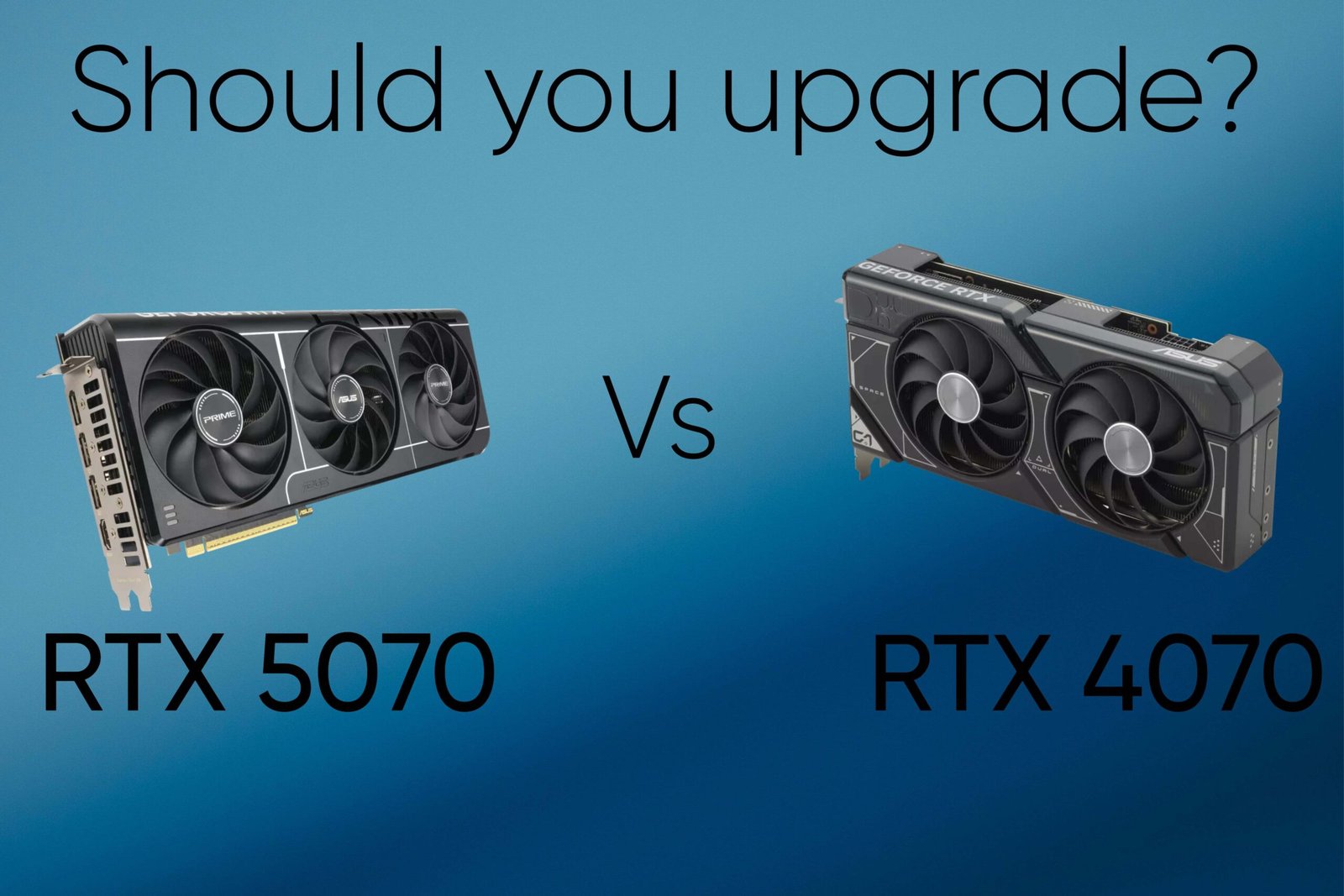
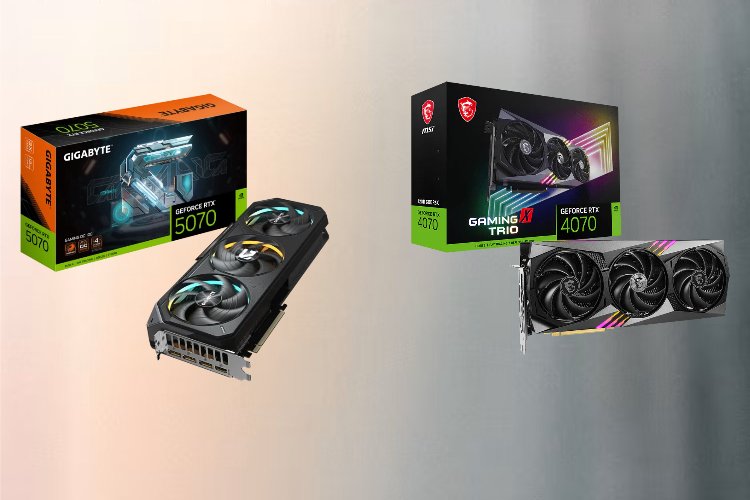
The RTX 5070 is the better graphics card. It’s around 10-20% faster in traditional gaming, delivers stronger ray tracing performance, and adds DLSS 4 with Multi Frame Generation. None of that is really up for debate.
What is up for debate is whether any of those improvements are worth spending money on if you already own an RTX 4070. Both cards still have 12GB of VRAM, both are built for 1440p gaming, and the RTX 4070 hasn’t suddenly become slow just because NVIDIA released something newer.
Buying new is a different story. The RTX 4070 has largely disappeared from store shelves, so unless you’re shopping on the used market, the RTX 5070 is the card you’re actually going to find. That makes this comparison less about choosing between two new GPUs and more about deciding whether the RTX 5070 is worth upgrading to—or whether a used RTX 4070 still makes sense if you can find one at the right price.
RTX 5070 vs RTX 4070 Specifications
| Specification | RTX 5070 | RTX 4070 |
|---|---|---|
| Architecture | Blackwell (GB205) | Ada Lovelace (AD104) |
| Process Node | TSMC 4N | TSMC 4N |
| CUDA Cores | 6,144 | 5,888 |
| RT Cores | 48 (4th Gen) | 46 (3rd Gen) |
| Tensor Cores | 192 (5th Gen) | 184 (4th Gen) |
| Base Clock | 2.33 GHz | 1.92 GHz |
| Boost Clock | 2.51 GHz | 2.48 GHz |
| VRAM | 12GB GDDR7 | 12GB GDDR6X |
| Memory Bus | 192-bit | 192-bit |
| Memory Speed | 28 Gbps | 21 Gbps |
| Memory Bandwidth | 672 GB/s | 504 GB/s |
| L2 Cache | 48 MB | 36 MB |
| PCIe Interface | PCIe 5.0 x16 | PCIe 4.0 x16 |
| TGP | 250W | 200W |
| Recommended PSU | 650W | 650W |
| Power Connector | 12V-2×6 (16-pin) | 16-pin (12VHPWR) or 8-pin* |
| Display Outputs | 3× DisplayPort 2.1b, 1× HDMI 2.1b | 3× DisplayPort 1.4a, 1× HDMI 2.1a |
| Launch MSRP | $549 | $599 |
The first thing most people notice is that both cards still come with 12GB of VRAM. If you were hoping NVIDIA would bump the RTX 5070 to 16GB, that didn’t happen. Instead, the company focused on making the memory much faster. The RTX 5070 switches to 28 Gbps GDDR7, pushing memory bandwidth up to 672 GB/s compared to 504 GB/s on the RTX 4070. Capacity hasn’t changed, but the way that memory performs certainly has.
The core count doesn’t tell the whole story either. Yes, the RTX 5070 has a few more CUDA cores, newer RT cores, and newer Tensor cores, but those numbers alone don’t explain why it’s faster. Most of the improvement comes from the Blackwell architecture itself. Across modern games, the RTX 5070 is typically around 10-20% faster, even though the hardware specifications don’t look dramatically different at first glance.
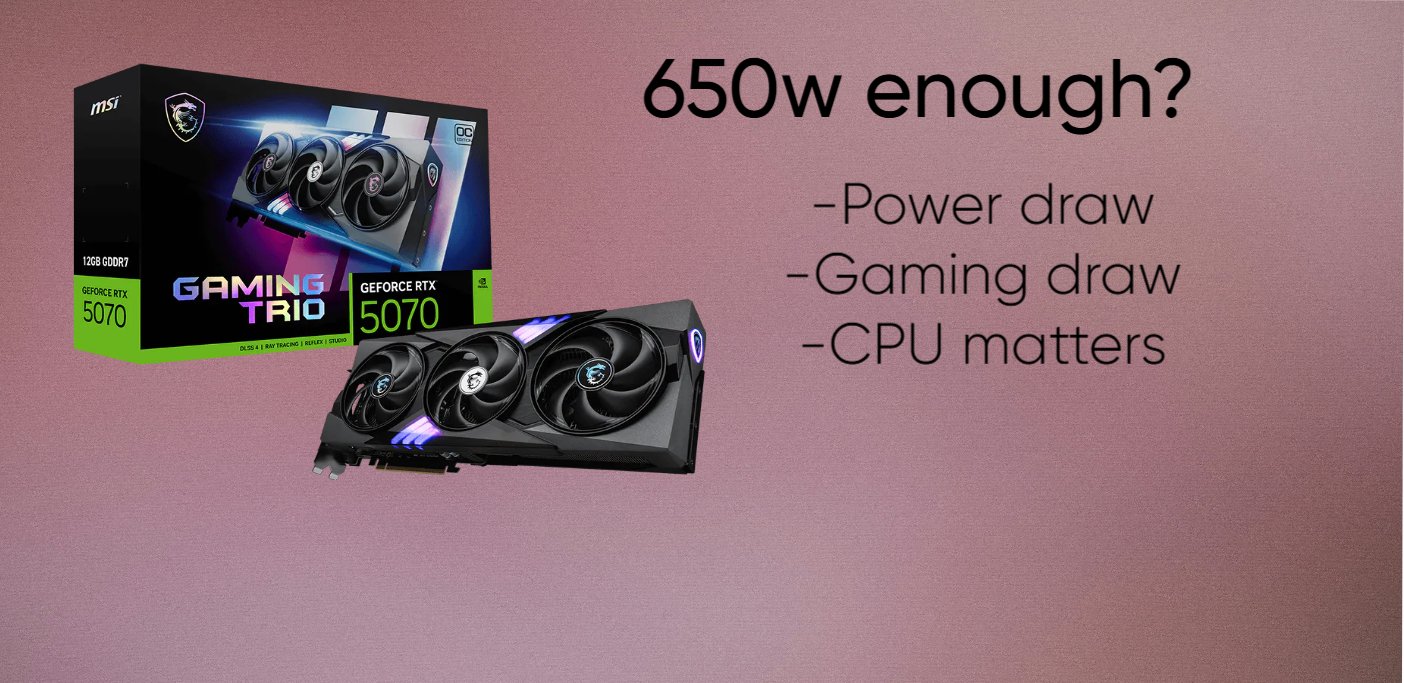
That extra performance isn’t free. Power draw climbs from 200W on the RTX 4070 to 250W on the RTX 5070. A 50W increase might sound like a lot on paper, but it’s fairly modest once you consider the jump in gaming performance and the move to faster GDDR7 memory. If you’re already using a quality 650W power supply, chances are you won’t need to change anything.
One upgrade that’s easy to overlook is DisplayPort 2.1b. It’s not something you’ll notice today if you’re gaming on a typical 1440p monitor, but it gives the RTX 5070 more breathing room for future high-refresh and higher-resolution displays. It’s a small improvement, but unlike extra RGB or cosmetic features, it’s one that could actually become useful over the next few years.
Raw Speed & Memory
The RTX 5070 doesn’t reinvent the wheel, but it’s noticeably quicker than the RTX 4070 once you get past 1080p. At that resolution the gap is usually under 10%, and unless you’re staring at an FPS counter, you probably won’t notice it. 1440p is a different story. That’s where the RTX 5070 opens up roughly a 20% lead, making much better use of high-refresh monitors. At 4K, the gap shrinks again because both cards eventually run into the same problem: 12GB of VRAM.
That might be the biggest surprise here. NVIDIA upgraded the memory to 28 Gbps GDDR7 and boosted bandwidth to 672 GB/s, but left capacity untouched. The extra bandwidth definitely helps, especially in newer games, yet it doesn’t magically solve the VRAM complaints people had with the RTX 4070. If a game wants more than 12GB, both cards end up making the same compromises.
Ray Tracing Performance
If ray tracing is one of the main reasons you’re buying a GeForce card, the RTX 5070 has a clear advantage.
In native ray-traced gaming, it’s typically 20–28% faster than the RTX 4070, with the biggest gains showing up in demanding games like Cyberpunk 2077, Alan Wake 2, and other Unreal Engine 5 titles. Those extra frames make a noticeable difference at 1440p, where ray tracing can quickly overwhelm mid-range GPUs. The RTX 4070 is still capable, but it’s much more likely to dip below the smooth 60 FPS mark once you start turning every visual setting up.
The bigger story, though, is DLSS 4.
Both graphics cards can use DLSS Super Resolution, so image reconstruction isn’t exclusive to the RTX 5070. The difference is Frame Generation. The RTX 4070 is limited to the original DLSS 3 Frame Generation, which creates a single AI-generated frame between every rendered frame. The RTX 5070 goes a step further with DLSS 4 Multi Frame Generation, allowing the GPU to generate multiple AI frames instead of just one. In games that support it, the result is a much larger jump in frame rate, making demanding ray-traced titles feel considerably smoother on high-refresh displays.
That doesn’t mean every game suddenly runs twice as fast. Multi Frame Generation is only available in supported titles, and like any frame generation technology, it works best when your native frame rate is already reasonably high. Start with a solid 60–70 FPS, and the RTX 5070 can deliver an experience that the RTX 4070 simply can’t match. Try using frame generation to rescue a game running at 30 FPS, and neither card is going to feel particularly good.
If you rarely enable ray tracing or mostly play competitive games, this probably isn’t enough to justify replacing an RTX 4070. But if you bought into the GeForce ecosystem because you enjoy pushing graphics settings to the limit, the RTX 5070 offers one of the biggest generational improvements outside of raw rasterization. It’s not just faster hardware—it’s a noticeably better ray tracing experience.
Content Creation & Streaming
If your PC spends as much time inside Premiere Pro or Blender as it does in games, the RTX 5070 is the easier recommendation. Exports finish sooner, renders are quicker, and AI-heavy tools benefit from the newer Tensor cores. You’re generally looking at a 15–25% improvement, depending on the application.
Streaming hasn’t changed nearly as much. The RTX 4070 already had one of the best hardware encoders on the market, so there isn’t a dramatic leap here. The RTX 5070 refines what’s already there with an updated NVENC encoder and better AI performance, but if streaming is the only thing you do, upgrading from a 4070 doesn’t make much sense.
Power Efficiency & PSU Requirements
The only area where the RTX 4070 clearly fights back is power consumption. A 200W graphics card that delivers this level of performance is still impressive, even a generation later. The RTX 5070 bumps that to 250W, so you are paying for the extra performance with another 50 watts.
In practice, though, most people won’t have to change anything. A quality 650W power supply is enough for either card, and the RTX 5070’s updated 12V-2×6 connector is simply a refinement of the older design rather than a reason to upgrade on its own.
Pricing
Finding a brand-new RTX 4070 has become increasingly difficult since NVIDIA discontinued the card. Most listings are now renewed, refurbished, or sold through third-party sellers, with prices typically starting around $600 depending on the model and condition.
The RTX 5070, on the other hand, is still widely available from major retailers, although prices currently sit around $750–800 for most partner cards. That means the newer GPU usually costs $100–150 more than a renewed or refurbished RTX 4070.
Check current RTX 5070 prices on Amazon Check current RTX 4070 (renewed) prices on Amazon
1440p Gaming Performance
The RTX 4070 built its reputation as an excellent 1440p graphics card, and that hasn’t changed. It still has no trouble handling modern AAA games at high or ultra settings, often staying comfortably above 60 FPS in demanding titles while pushing much higher frame rates in competitive games.
The RTX 5070 simply does the same job with more breathing room. Across a wide range of modern games, it’s usually around 18–22% faster at 1440p, giving you extra performance that becomes increasingly useful as games continue to get more demanding. Instead of sitting around 70 FPS, you’re often looking at something closer to 85–90 FPS before enabling any upscaling.
The faster GDDR7 memory also helps here. Both cards still carry 12GB of VRAM, so neither completely escapes the occasional memory limitation in the newest releases. What the RTX 5070 does offer is 33% more memory bandwidth, allowing it to move textures and game data much faster. It doesn’t eliminate the VRAM ceiling, but it does help maintain steadier performance in heavier scenes and reduces some of the slowdowns that appear when games become especially demanding.
Ray tracing widens the gap even further. The RTX 4070 is still capable, but once you enable heavier RT effects, it starts losing performance much more quickly. The RTX 5070’s stronger RT hardware and support for DLSS 4 Multi Frame Generation make it much easier to enjoy ray tracing at 1440p without feeling like you’re sacrificing half your frame rate.
If you’re buying a graphics card today primarily for 1440p gaming, the RTX 5070 is the better long-term choice. The RTX 4070 still delivers an excellent experience—especially if you already own one—but the extra performance headroom on the RTX 5070 will become more valuable as future games continue to demand more from modern GPUs.
| Game | RTX 5070 | RTX 4070 | Settings |
|---|---|---|---|
| Cyberpunk 2077 | 88 FPS | 73 FPS | Ultra / Native |
| Black Myth: Wukong | 61 FPS | 50 FPS | Cinematic / Native |
| Call of Duty: Black Ops 6 | 168 FPS | 141 FPS | Extreme / Native |
| Hogwarts Legacy | 104 FPS | 86 FPS | Ultra / Native |
| Forza Horizon 5 | 156 FPS | 131 FPS | Extreme / Native |
| Starfield | 82 FPS | 68 FPS | Ultra / Native |
| Assassin’s Creed Shadows | 70 FPS | 58 FPS | Ultra High / Native |
| Marvel’s Spider-Man 2 | 110 FPS | 92 FPS | Very High / Native |
Test system: AMD Ryzen 7 9800X3D, 32GB DDR5-6000 memory, Windows 11 24H2. Benchmarks were conducted at 2560×1440 using each game’s highest native graphics preset with ray tracing, DLSS, Frame Generation, XeSS, and FSR disabled.
Also read: Best 1440p GPUs for gaming in 2026
4K Gaming Performance
Neither the RTX 5070 nor the RTX 4070 was built to be a no-compromise 4K Ultra graphics card, but both can deliver an excellent experience if you’re willing to use DLSS. Without upscaling, demanding games like Cyberpunk 2077, Black Myth: Wukong, and Alan Wake 2 will often fall below 60 FPS at maximum settings. Less demanding titles such as Forza Horizon 5, Call of Duty, and most esports games are much easier to run natively.
The RTX 5070 holds a clear advantage once the resolution jumps to 4K. Across modern games, it’s typically 15–25% faster than the RTX 4070, which is often the difference between hovering around 45 FPS and staying much closer to or around 60 FPS. That’s a much more noticeable improvement than it is at 1080p, where both cards already have performance to spare.
A big reason for that lead is memory bandwidth. The RTX 5070 upgrades to 28 Gbps GDDR7, increasing bandwidth from 504 GB/s to 672 GB/s. At 4K, the GPU has to process more than 8 million pixels every frame while constantly streaming large textures into memory. The extra bandwidth helps keep the GPU fed with data, reducing slowdowns in demanding scenes and giving the RTX 5070 more consistent performance.
DLSS also plays a much bigger role at this resolution. Both cards support DLSS Super Resolution, making 4K gaming far more achievable than it would be natively. The RTX 5070 goes a step further with DLSS 4 Multi Frame Generation, allowing supported games to reach frame rates that simply aren’t possible on the RTX 4070. If your goal is high-refresh 4K gaming, that’s one of the biggest advantages of the newer card.
The one limitation both GPUs share is 12GB of VRAM. It’s still enough for the vast majority of games, especially when using DLSS, but a handful of newer titles with ultra-resolution texture packs can push close to that limit. Faster GDDR7 memory helps the RTX 5070 cope with that pressure better than the RTX 4070, but it doesn’t completely remove the limitation. If you’re planning to keep your next graphics card for many years and play everything at native 4K Ultra, more VRAM would still be nice to have.
RTX 5070 vs RTX 4070: Which Should You Buy?
For anyone building a new gaming PC, the choice is pretty straightforward. The RTX 5070 is faster in every modern game, delivers noticeably better ray tracing performance, supports DLSS 4 Multi Frame Generation, and launched at a lower MSRP than the RTX 4070 did. Since the RTX 4070 has also been phased out, finding a brand-new card at a sensible price is becoming increasingly difficult. Unless you come across an exceptional deal, the RTX 5070 is the graphics card that makes more sense today.
The decision changes if you already own an RTX 4070. The RTX 5070 is undoubtedly the better GPU, but a 20% improvement in gaming performance isn’t the kind of upgrade that completely changes the experience. Both cards still target 1440p gaming, both have 12GB of VRAM, and both remain capable of handling modern AAA titles. If your RTX 4070 is doing everything you need it to, there’s little reason to replace it after just one generation.
The RTX 4070 is still worth considering on the used market. If you can find one in good condition for significantly less than a new RTX 5070, it remains an excellent 1440p graphics card with strong ray tracing performance and access to NVIDIA’s software ecosystem. Just don’t pay new-GPU money for hardware that’s no longer in production.
For most buyers in 2026, the RTX 5070 is the better purchase. It offers more performance, newer features, and a longer runway for future games. The RTX 4070 hasn’t suddenly become obsolete, but at this point it makes the most sense as a well-priced used buy rather than a new one.
Read our standalone RTX 5070 review here Read our standalone RTX 4070 review here
Check current RTX 5070 prices on Amazon
FAQs
Is the RTX 5070 faster than the RTX 4070?
Yes. In traditional rasterized gaming, the RTX 5070 is typically around 18–22% faster at 1440p. The lead becomes even larger in ray-traced games thanks to its newer Blackwell architecture and DLSS 4 support.
Is the RTX 5070 worth upgrading from the RTX 4070?
For most RTX 4070 owners, probably not. While the RTX 5070 is noticeably faster, both cards still target 1440p gaming and share the same 12GB of VRAM. Unless you specifically want DLSS 4 Multi Frame Generation, stronger ray tracing performance, or higher frame rates, the upgrade isn’t essential.
Can the RTX 5070 handle 4K gaming?
Yes. The RTX 5070 is capable of 4K gaming, especially when using DLSS. Less demanding games run well at native 4K, while newer AAA titles benefit greatly from DLSS and Frame Generation to maintain smooth frame rates.
Does the RTX 4070 support DLSS 4?
Yes, but with a limitation. The RTX 4070 supports DLSS 4 Super Resolution, but it’s limited to the original Frame Generation hardware introduced with DLSS 3. It doesn’t support Multi Frame Generation, which is exclusive to NVIDIA’s newer Blackwell GPUs like the RTX 5070.
Is 12GB of VRAM enough in 2026?
For 1080p and 1440p gaming, 12GB is still sufficient for the vast majority of games. At 4K, some newer titles with ultra-quality texture packs can begin pushing that limit, although using DLSS helps reduce VRAM pressure in many cases.
Which GPU is better for content creation?
The RTX 5070 is the stronger choice for creators. It offers faster rendering in applications like Blender, better AI performance, and improved hardware acceleration for video editing and creative workloads.
Is the RTX 5070 more power hungry than the RTX 4070?
Yes. The RTX 5070 has a 250W TGP, compared to 200W for the RTX 4070. Despite the higher power draw, it also delivers a meaningful performance increase, so overall efficiency remains competitive.
Should I buy a used RTX 4070 or a new RTX 5070?
If the price difference is small, the RTX 5070 is the better investment thanks to its higher performance, newer features, and longer software support. A used RTX 4070 only makes sense if you can find one at a significantly lower price in good condition.
Also read
RTX 5060 Review: Is 8gb VRAM enough in 2026
RTX 4070 Ti SUPER vs RTX 5070: Which offers better value?
RTX 5070 ti vs RTX 5070: Worth the Extra Money?
RTX 5060 vs RTX 4060: Is it worth the upgrade?
RTX 4060 vs RX 7600: Which is the better buy in 2026?
Intel Arc B580 vs RTX 5060: Don’t buy until you read this
Is the RTX 5060 Ti good for 1440p gaming
RX 9060 XT Review: The Best GPU for 1080p Gaming Right Now?
Best GPUs for 1080p gaming in 2026
RX 9070 XT Review: Is it really future proof?
Is RTX 4060 it still worth buying in 2026?
RX 9070 review: Is it REALLY worth your money?
Best 1440p GPUs for Gaming in 2026
RTX 5070 review: The best 1440p GPU in 2026?
RX 7600 Review: Is it still worth buying in 2026
RTX 5060 vs RX 9060 XT: Which is the best 1080p GPU
RTX 4070 review: Is it worth buying in 2026?
Samsung 990 Pro SSD review 2026
Logitech Superlight G Pro X Review
RTX 5060 ti vs RX 9060 XT: Is NVIDIA worth paying $100 more?
As an Amazon Associate I earn from qualifying purchases

Leave a Reply