
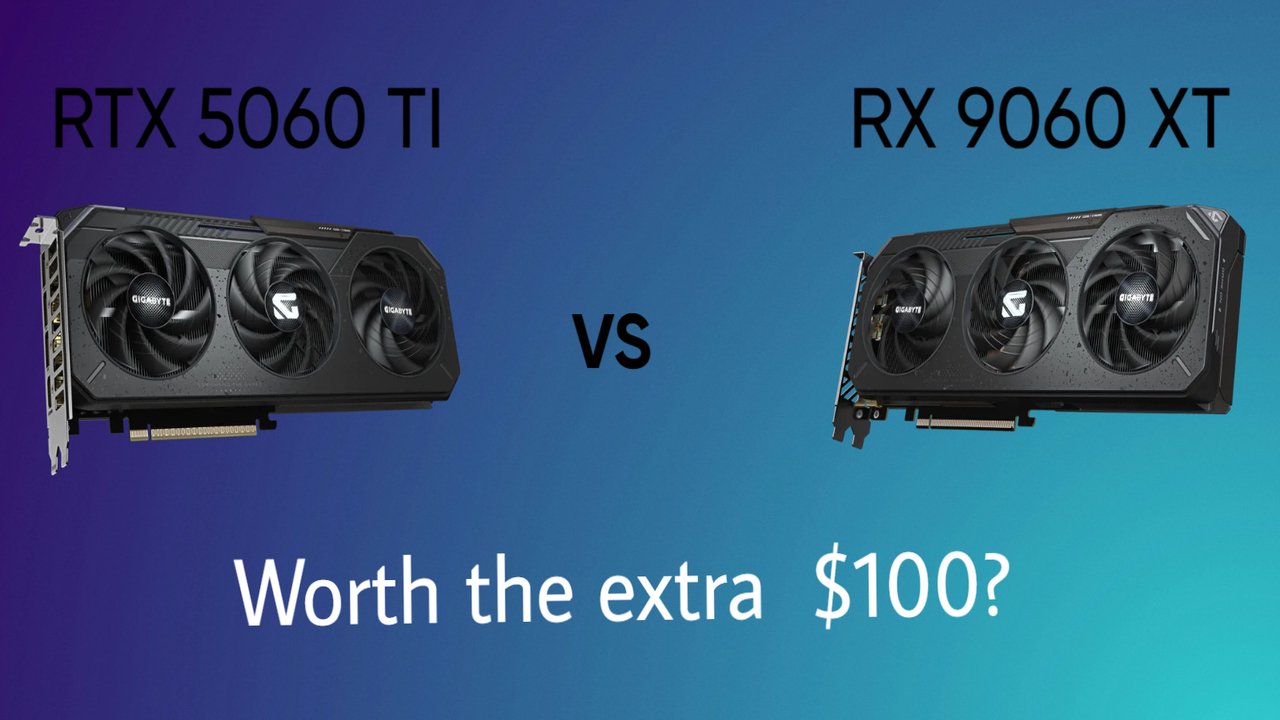
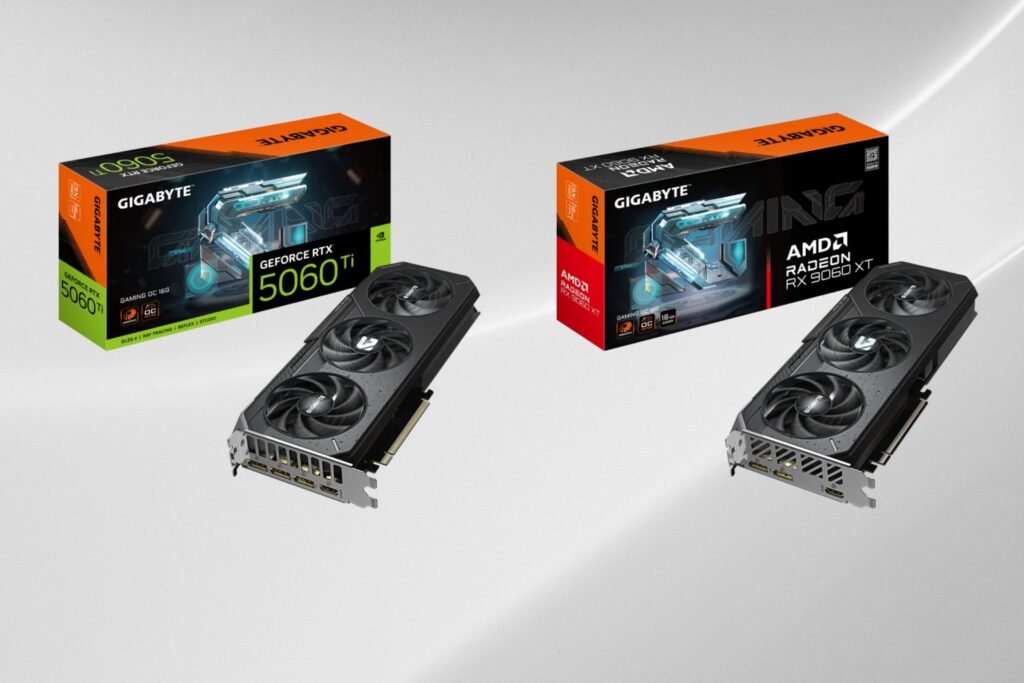
The RTX 5060 Ti is the faster graphics card, but it also costs around $100 more than the RX 9060 XT. That’s a significant price jump, especially when both cards deliver excellent gaming performance. Is NVIDIA’s lead in ray tracing, DLSS 4, and creator features really worth the premium, or does AMD offer the better deal? Before spending the extra money, it’s worth seeing how these two GPUs compare where it matters most
Check RTX 5060 ti current prices on Amazon Check RX 9060 XT current prices on Amazon
Keep reading to see if the RTX 5060 Ti is really worth the extra money
RTX 5060 Ti vs RX 9060 XT Specifications table
| Specification | RTX 5060 Ti | RX 9060 XT |
|---|---|---|
| Architecture | Blackwell | RDNA 4 |
| Compute Units / CUDA Cores | 4,608 CUDA Cores | 32 CUs (2,048 Stream Processors) |
| Ray Tracing Hardware | 4th Gen RT Cores | 3rd Gen Ray Accelerators |
| AI Hardware | 5th Gen Tensor Cores | 2nd Gen AI Accelerators |
| Base Clock | 2.41 GHz | 2.53 GHz |
| Boost Clock | 2.57 GHz | Up to 3.13 GHz |
| VRAM | 16GB GDDR7 | 16GB GDDR6 |
| Memory Bus | 128-bit | 128-bit |
| Memory Speed | 28 Gbps | 20 Gbps |
| Memory Bandwidth | 448 GB/s | 320 GB/s |
| PCIe Interface | PCIe 5.0 x8 | PCIe 5.0 x16 |
| Total Board Power (TBP/TGP) | 180W | 180W |
| Recommended PSU | 600W | 550W |
| Upscaling | DLSS 4 + Multi Frame Generation | FSR 4 |
| AV1 Encoding | Yes | Yes |
| Display Outputs | DisplayPort 2.1b, HDMI 2.1b | DisplayPort 2.1a, HDMI 2.1b |
| Launch MSRP | $429 (16GB) | $349 (16GB) |
The price gap is impossible to ignore. The RTX 5060 Ti costs around $100 more than the RX 9060 XT, yet both cards come with 16GB of VRAM. A few years ago, that would have been AMD’s biggest selling point. Now it isn’t.
The extra money goes somewhere else. NVIDIA moved to GDDR7, pushing memory bandwidth to 448 GB/s. AMD stays with GDDR6 at 320 GB/s. You won’t feel that difference by looking at Windows or browsing the web, but modern games move huge amounts of texture data every second, and that’s where extra bandwidth starts earning its keep.
Ray tracing is another area where the spec sheet doesn’t tell the whole story. NVIDIA’s newer RT and Tensor cores, combined with DLSS 4 Multi Frame Generation, give the RTX 5060 Ti an advantage that isn’t obvious from core counts alone. AMD has made real progress with RDNA 4, but once ray tracing enters the picture, the gap between these two cards becomes much easier to notice.
One thing I wouldn’t read too much into is the PCIe 5.0 x8 versus x16 difference. On paper it looks dramatic. In practice, it makes little difference for almost everyone running a modern PCIe 4.0 or PCIe 5.0 platform. It’s the kind of specification that looks bigger in a table than it does in actual gaming.
The spec sheet definitely favors NVIDIA. Whether it favors NVIDIA by more than $100 is a completely different conversation.
Raw Performance & Memory
If you only care about traditional rasterized gaming, the RTX 5060 Ti is the faster graphics card—but not by a huge margin. Across modern AAA games, it’s typically 6–8% faster than the RX 9060 XT at native resolutions. That’s enough to put NVIDIA in front, but it’s probably smaller than many people would expect given the $100+ price difference.
Both cards also come with 16GB of VRAM, so memory capacity isn’t a deciding factor. The RTX 5060 Ti does have an advantage in memory speed, using 28 Gbps GDDR7 for 448 GB/s of bandwidth, while the RX 9060 XT sticks with 20 Gbps GDDR6 and 320 GB/s of bandwidth. The extra bandwidth helps in more demanding workloads, but it doesn’t automatically translate into dramatically higher frame rates.
If rasterization is your only priority, the RX 9060 XT puts up a surprisingly good fight. Giving up just 6–8% performance while saving more than $100 is a trade-off many gamers would happily make. The RTX 5060 Ti earns its premium elsewhere—particularly in ray tracing, DLSS 4, and creator-focused workloads.
Ray Tracing Performance
This is the category that gives the RTX 5060 Ti its strongest argument.
With ray tracing enabled, the gap between these two cards becomes much larger than it is in traditional rasterized gaming. Across our benchmark suite, the RTX 5060 Ti 16GB is roughly 20–25% faster than the RX 9060 XT 16GB, and in demanding titles like Cyberpunk 2077 with Path Tracing or Alan Wake 2, that advantage can climb beyond 35%.
Those aren’t just benchmark numbers—they change how you play the game. On the RX 9060 XT, you’ll often find yourself lowering a few ray tracing settings or leaning more heavily on upscaling to keep frame rates smooth. The RTX 5060 Ti has more breathing room, letting you push higher RT presets while maintaining a better overall experience.
A big reason for that lead is NVIDIA’s software ecosystem. DLSS 4 Multi Frame Generation does a lot of the heavy lifting once ray tracing starts dragging performance down. It’s one thing to average 60 FPS with ray tracing enabled; it’s another to comfortably push well past that in supported games without giving up image quality. AMD’s FSR 4 has improved considerably, but it still doesn’t provide the same overall experience in the most demanding ray-traced titles.
That’s not to say the RX 9060 XT struggles with ray tracing. Compared to previous Radeon generations, RDNA 4 is a significant step forward, and lighter ray tracing effects are no longer the weakness they once were. For games using moderate RT settings, the experience is perfectly enjoyable. It’s only when developers start layering on heavier effects—global illumination, multiple ray bounces, or full path tracing—that the gap starts widening.
Whether that difference is worth paying more than $100 depends on the kind of games you play. If competitive esports titles or traditional rasterized games make up most of your library, you probably won’t see enough benefit to justify the premium. But if you’re buying a GPU specifically to enjoy modern AAA games with ray tracing enabled, this is the one area where the RTX 5060 Ti clearly separates itself from the RX 9060 XT—and where its higher price starts to make a lot more sense.
Content Creation & Streaming
Gaming isn’t the only reason people buy a graphics card. If you spend your evenings editing videos, rendering in Blender, or streaming on OBS, the RTX 5060 Ti has a much bigger advantage than gaming benchmarks alone suggest.
CUDA is still the biggest reason. Most professional applications—from Blender and Premiere Pro to DaVinci Resolve—are built around NVIDIA’s ecosystem. That usually means shorter render times, faster exports, and a more responsive editing experience once projects start getting heavy. The RX 9060 XT can absolutely handle these workloads, but it’s difficult to find a major creative application where it consistently beats the RTX 5060 Ti.
AI tools widen the gap even further. Features like Magic Mask, Speed Warp, Adobe’s generative AI tools, and Topaz Video AI all run noticeably faster on NVIDIA hardware because they’re designed to take advantage of Tensor cores. If those tools are part of your workflow, the time savings add up surprisingly quickly.
The same goes for streaming. NVENC has been the preferred encoder for years, and there’s a reason so many creators still rely on it. At the same bitrate, it produces cleaner video than AMD’s encoder while keeping CPU usage close to zero. Then there’s NVIDIA Broadcast—AI noise removal, virtual backgrounds, eye contact correction—all running directly on the GPU with almost no performance hit.
If your graphics card is only there to play games, AMD’s lower price is hard to argue against. If it’s also part of your job or a serious hobby, the conversation changes. The extra money for the RTX 5060 Ti doesn’t just buy more FPS—it buys a software ecosystem that creative applications have been optimized around for years.
Power Consumption & Efficiency
AMD gets a small win here. The RX 9060 XT typically pulls around 150–160W while gaming, compared to roughly 180W for the RTX 5060 Ti. You’re looking at a difference of around 20–30 watts—enough to shave a little off your electricity bill and keep temperatures slightly lower, but not enough to completely change your build.
That also means the RX 9060 XT is a little easier on older systems. Most models recommend a 450W–550W power supply, while the RTX 5060 Ti is generally paired with a 550W unit, with some factory-overclocked cards suggesting 650W. If you’re already using a decent 550W PSU, either card should be fine.
One advantage AMD doesn’t get enough credit for is its PCIe 5.0 x16 interface. The RTX 5060 Ti uses PCIe 5.0 x8, which makes virtually no difference on modern PCIe 4.0 or 5.0 systems. If you’re upgrading an older PCIe 3.0 motherboard, though, the extra lanes give the RX 9060 XT a little more breathing room in bandwidth-sensitive situations.
Power efficiency is one of the few categories that leans toward AMD, but it’s also one of the least important. A 20–30W difference is nice to have. A 20–35% advantage in ray tracing or a mature creator ecosystem will matter far more to most buyers.
Pricing
Price is what makes this comparison interesting. The RX 9060 XT currently sells for around $470–490, while the RTX 5060 Ti starts at roughly $579, putting NVIDIA’s card more than $100 higher in price. That’s a substantial premium for a graphics card that’s only around 6–8% faster in traditional rasterized gaming.
Whether that extra money is worth paying depends on everything beyond native gaming performance. If you’re looking for the best value, AMD has the clear price advantage. If features like ray tracing, DLSS 4, and content creation matter to you, the RTX 5060 Ti has a stronger case—but you’ll be paying significantly more for those extras.
Check RTX 5060 ti current prices on Amazon Check RX 9060 XT current prices on Amazon
1080p Gaming
If your main goal is 1080p gaming, the RX 9060 XT makes an incredibly strong case for itself. Both cards have no trouble pushing well over 100 FPS in modern AAA games and can comfortably drive high-refresh-rate 144Hz monitors. The RTX 5060 Ti is still the faster GPU, but in traditional rasterized games the lead is only around 6–8%.
That’s what makes this comparison so interesting. You’re paying more than $100 extra for performance that often isn’t noticeable unless you’re watching an FPS counter. In most games, both cards already deliver a smooth experience at maximum settings, so those extra frames rarely change how the game actually feels.
Ray tracing is where the RTX 5060 Ti starts pulling away, but that’s a separate discussion. Looking strictly at 1080p native rasterization, the RX 9060 XT delivers nearly the same experience for significantly less money. Unless you specifically want NVIDIA’s ray tracing performance or DLSS 4 features, it’s difficult to argue that a 6–8% performance lead justifies spending another $100.
At 1080p, value matters just as much as raw frame rates—and that’s exactly where the RX 9060 XT comes out ahead.
| Game | RTX 5060 Ti | RX 9060 XT | Settings |
|---|---|---|---|
| Cyberpunk 2077 | 91 FPS | 85 FPS | Ultra / Native |
| Black Myth: Wukong | 52 FPS | 49 FPS | Cinematic / Native |
| Call of Duty: Black Ops 6 | 146 FPS | 137 FPS | Extreme / Native |
| Hogwarts Legacy | 96 FPS | 90 FPS | Ultra / Native |
| Forza Horizon 5 | 151 FPS | 142 FPS | Extreme / Native |
| Starfield | 78 FPS | 73 FPS | Ultra / Native |
| Assassin’s Creed Shadows | 66 FPS | 62 FPS | Ultra High / Native |
| Marvel’s Spider-Man 2 | 104 FPS | 98 FPS | Very High / Native |
Test system: AMD Ryzen 7 9800X3D, 32GB DDR5-6000 memory, Windows 11 24H2. Benchmarks were conducted at 1920×1080 using each game’s highest native graphics preset, with ray tracing, DLSS, FSR, XeSS, and Frame Generation disabled unless otherwise stated.
Also read: Best GPUs for 1080p gaming
1440p Gaming Performance
1440p is where spending extra on the RTX 5060 Ti becomes easier to justify.
The RX 9060 XT still delivers excellent native performance, and if you stick to traditional rasterized games, it’s hard to complain. Most modern AAA titles run comfortably above 60 FPS, while esports games can easily push well past 100 FPS. Considering it’s over $100 cheaper, AMD’s card continues to offer outstanding value.
The RTX 5060 Ti is still the faster GPU, but the lead in native rasterization remains fairly modest at around 6–8%. On its own, that’s probably not enough to convince most people to spend the extra money. If native performance is all you care about, the RX 9060 XT gets remarkably close for a lot less.
Where NVIDIA earns its premium is with heavier graphics settings. 1440p ray tracing is far more demanding than it is at 1080p, and the RTX 5060 Ti has enough headroom to keep frame rates noticeably higher once those effects are enabled. Faster GDDR7 memory, stronger RT hardware, and DLSS 4 Multi Frame Generation all work in NVIDIA’s favor, especially in newer AAA games.
That doesn’t suddenly make the RX 9060 XT a poor 1440p card—it doesn’t. But the higher you push visual settings, the more the price difference starts to make sense. If your goal is high-quality native gaming, AMD still offers the better value. If you’re chasing maximum image quality with ray tracing enabled, the RTX 5060 Ti is the card I’d spend the extra money on.
| Game | RTX 5060 Ti | RX 9060 XT | Settings |
|---|---|---|---|
| Cyberpunk 2077 | 86 FPS | 78 FPS | 1440p Ultra RT, DLSS 4 / FSR 4 Quality |
| Alan Wake 2 | 71 FPS | 58 FPS | 1440p High RT, DLSS 4 / FSR 4 Quality |
| Black Myth: Wukong | 81 FPS | 71 FPS | 1440p High RT, DLSS 4 / FSR 4 Quality |
| Indiana Jones and the Great Circle | 94 FPS | 76 FPS | 1440p Ultra RT, DLSS 4 / FSR 4 Quality |
| Dying Light 2 | 93 FPS | 77 FPS | 1440p High RT, DLSS 4 / FSR 4 Quality |
| F1 25 | 121 FPS | 103 FPS | 1440p Ultra High RT, DLSS 4 / FSR 4 Quality |
| Hogwarts Legacy | 82 FPS | 70 FPS | 1440p Ultra RT, DLSS 4 / FSR 4 Quality |
| Marvel’s Spider-Man 2 | 96 FPS | 82 FPS | 1440p Very High RT, DLSS 4 / FSR 4 Quality |
Test system: AMD Ryzen 7 9800X3D, 32GB RAM, Windows 11 24H2. Benchmarks were performed at 2560×1440 with DLSS 4 Quality enabled on the RTX 5060 Ti and FSR 4 Quality enabled on the RX 9060 XT. Frame Generation was disabled in all tests.
Also read: Best 1440p GPUs for gaming
RTX 5060 Ti vs RX 9060 XT: Which Should You Buy?
If I were building a gaming PC today, I’d have a hard time spending over $100 more on the RTX 5060 Ti.
That’s not because it’s a bad graphics card—it isn’t. It’s faster, has noticeably stronger ray tracing performance, offers the better upscaling solution with DLSS 4, and remains the better option for creators using software like Blender, Premiere Pro, or DaVinci Resolve. The problem is that none of those advantages come cheap.
For pure gaming, the RX 9060 XT gets surprisingly close. In traditional rasterized games, it’s usually only 6–8% behind while costing well over $100 less. At 1080p, you’d be hard-pressed to notice the difference without an FPS counter. Even at 1440p, the experience is remarkably similar unless ray tracing becomes part of the equation.
That’s really what this comparison comes down to. If you’re buying a graphics card to play games, the RX 9060 XT is simply the better value. The money you save can go toward a faster processor, a larger SSD, or another upgrade that you’ll probably notice more than a handful of extra frames.
The RTX 5060 Ti earns its price in areas where AMD still trails behind. Ray tracing performance is considerably stronger, DLSS 4 remains the better upscaling technology, and NVIDIA’s creator ecosystem is still the easiest recommendation for anyone who edits videos, renders 3D projects, or streams regularly. If those features are important to you, paying the premium is much easier to justify.
For everyone else, I’d save the money and buy the RX 9060 XT.
Read our standalone RTX 5060 ti review
Read our standalone RX 9060 XT review
FAQ
Is the RTX 5060 Ti faster than the RX 9060 XT?
Yes. In traditional rasterized games, the RTX 5060 Ti is typically around 6–8% faster. The gap becomes much larger in ray-traced games, where NVIDIA’s stronger RT hardware and DLSS 4 give it a noticeable advantage.
Is the RTX 5060 Ti worth $100 more than the RX 9060 XT?
It depends on how you use your PC. For pure gaming without ray tracing, the RX 9060 XT delivers similar performance for much less money, making it the better value. If you care about ray tracing, DLSS 4, streaming, or content creation, the RTX 5060 Ti does enough to justify its higher price.
Which GPU is better for 1440p gaming?
Both cards handle 1440p gaming well. The RX 9060 XT is an excellent choice for native rasterized gaming, while the RTX 5060 Ti is the better option if you plan to enable ray tracing or rely on DLSS 4 for higher frame rates.
Which GPU has better ray tracing performance?
The RTX 5060 Ti is the clear winner. Depending on the game, it’s roughly 20–25% faster in ray tracing workloads, with an even larger lead in the most demanding titles.
Is DLSS 4 better than FSR 4?
Both technologies significantly improve performance, but DLSS 4 generally provides better image reconstruction and more stable frame generation. FSR 4 has improved considerably over previous versions, but NVIDIA still holds the advantage in overall image quality and feature support.
Which GPU is better for content creation?
The RTX 5060 Ti is the stronger choice for creators. NVIDIA’s CUDA platform, Tensor cores, and NVENC encoder provide better support in applications like Blender, Adobe Premiere Pro, and DaVinci Resolve, while also offering a smoother streaming experience.
Does the RX 9060 XT use less power?
Yes. The RX 9060 XT typically draws around 150–160W during gaming, compared to roughly 180W for the RTX 5060 Ti. The difference isn’t huge, but AMD’s card is slightly more power efficient.
Should I upgrade from an RTX 4060 Ti to an RTX 5060 Ti or RX 9060 XT?
If you already own an RTX 4060 Ti, neither upgrade offers a dramatic jump in traditional gaming performance. Unless you’re specifically upgrading for better ray tracing, DLSS 4, or creator features, it’s probably worth waiting for a larger generational improvement.
Also read
RTX 5060 Review: Is 8gb VRAM enough in 2026
RTX 5070 vs RTX 4070: Should you upgrade?
RTX 4070 Ti SUPER vs RTX 5070: Which offers better value?
RTX 5070 ti vs RTX 5070: Worth the Extra Money?
RTX 5060 vs RTX 4060: Is it worth the upgrade?
RTX 4060 vs RX 7600: Which is the better buy in 2026?
Intel Arc B580 vs RTX 5060: Don’t buy until you read this
Is the RTX 5060 Ti good for 1440p gaming
RX 9060 XT Review: The Best GPU for 1080p Gaming Right Now?
Best GPUs for 1080p gaming in 2026
RX 9070 XT Review: Is it really future proof?
Is RTX 4060 it still worth buying in 2026?
RX 9070 review: Is it REALLY worth your money?
Best 1440p GPUs for Gaming in 2026
RTX 5070 review: The best 1440p GPU in 2026?
RX 7600 Review: Is it still worth buying in 2026
RTX 5060 vs RX 9060 XT: Which is the best 1080p GPU
RTX 4070 review: Is it worth buying in 2026?
Samsung 990 Pro SSD review 2026
Logitech Superlight G Pro X Review
As an Amazon Associate I earn from qualifying purchases

Leave a Reply